Multiplying by powers of ten
Follow the following useful and easy shortcuts when multiplying by powers of ten.
When multiplying a whole number by a positive power of ten, just count how many zero(s) you have and attached that to the right of the whole number.
Examples:
1) 56 × 10
There is only one zero, so 56 × 10 = 560
2) 45 × 10,000
There are 4 zeros, so 45 × 10000 = 450000
3) 18 × 10,000,000
There are 7 zeros, so 18 × 10,000,000 = 180,000,000
When multiplying a whole number by a negative power of ten (negative exponent), move the decimal point one place to the left for each zero you see before the 1.
Examples:
1) 38 × 0.1
There is only one zero before the 1, so 38 × 0.1 = 3.8
2) 99 × 0.01
There are 2 zeros before the 1, so 99 × 0.01 = 0.99
Decimals multiplied by powers of 10
When multiplying a decimal by a positive power of ten (positive exponent), move the decimal point one place to the right for each zero you see after the 1.
Examples:
1) 0.56 × 10
There is only one zero, so move the decimal point one place to the right.
0.56 × 10 = 5.6
2) 0.56 × 100
There are 2 zeros, so move the decimal point two places to the right.
0.56 × 100 = 56
3) 0.056 × 1000
There are three zeros, so move the decimal point 3 places to the right.
0.056 × 1000 = 56
4) 0.056 × 100,000
0.056 × 100,000 = 0.056 × 1000 × 100 = 56 × 100 = 5600
When multiplying a decimal by a negative power of ten (negative exponent), move the decimal point one place to the left for each zero you see before the 1.
Note that 0.1 = 10-1, 0.01 = 10-2, 0.001 = 10-3, and so forth....
We call 10-1, 10-2, and 10-3 negative powers of 10 because the exponents are negative.
Examples:We call 10-1, 10-2, and 10-3 negative powers of 10 because the exponents are negative.
1) 56 × 0.1
There is only one zero, so move the decimal point one place to the left.
56 × 0.1 = 5.6
2) 560 × 0.01
There are 2 zeros, so move the decimal point two places to the left.
560 × 0.01 = 5.6
2) 560 × 0.001
There are 3 zeros, so move the decimal point two places to the left.
560 × 0.001 = 0.560
3) 0.56 × 0.1
There is only one zero, so move the decimal point one place to the left.
0.56 × 0.1 = 0.056
4) 0.56 × 0.01
There are 2 zeros, so move the decimal point two places to the left.
0.56 × 0.01 = 0.0056
Any questions about multiplying by powers of ten? Let me know...
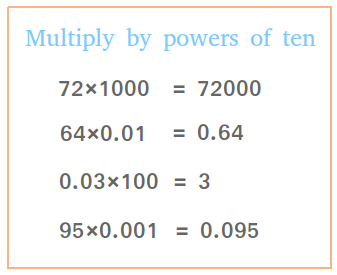
Summary showing how multiplying by powers of ten works

100 Tough Algebra Word Problems.
If you can solve these problems with no help, you must be a genius!

Recommended