Prime number
A prime number is a number that is divisible only by 1 and itself. A number is divisible by another number when the remainder is zero.
For example, 7 is a prime number because 7 is only divisible by 1 and 7. This means that if you divide 7 by a number that is not 1 or 7, you will not get a remainder of zero.
7 divided by 1 gives a remainder of 0 since 7 = 1 × 7 + 0
7 divided by 2 gives a remainder of 1 since 7 = 2 × 3 + 1
7 divided by 3 gives a remainder of 1 since 7 = 3 × 2 + 1
7 divided by 4 gives a remainder of 3 since 7 = 4 × 1 + 3
7 divided by 5 gives a remainder of 2 since 7 = 5 × 1 + 2
7 divided by 6 gives a remainder of 1 since 7 = 6 × 1 + 1
7 divided by 7 gives a remainder of 0 since 7 = 7 × 1 + 0
As illustrated above, only when 7 is divided by 1 and 7 will you get a remainder of zero. We can also say that the only factors of 7 are 1 and 7. This gives us a second way to define a prime number.
Definition #2: A number is prime if the number has only 2 factors, 1 and itself.
If the number has more than two factors, we say that the number is composite.
For instance, 12 is a composite number because 12 has more than 2 factors. It can be divided by numbers other than 1 and 12, such as 2, 3, and 4 which can also be called factors.
A few interesting facts about prime numbers
- 1 is neither prime nor composite because it has only one factor. According to the definition, a number must have at least 2 factors before it can be prime or composite.
- Notice also that 2 is the only number that is even and prime at the same time.
- There are 15 prime numbers less than 50.
- There are 25 prime numbers less than 100. Can you find them?
You can use the definition to test every single number. However, it is somewhat time-consuming.
As a shortcut, you can use a method or algorithm called Sieve of Eratosthenes, named after a famous Greek mathematician.
Using Sieve's algorithm to find prime numbers between 1 and 50.
- Make a list of all numbers from 1 to 50.
- Start by crossing out 1 because it is not prime. Then, circle the next number after 1 that is prime, which is 2.
- Cross out all the multiples of 2 until you get to 50, such as 2, 6, 8, 10, 12...
- Look for the next number after 2 that is prime. That number is 3. Circle 3 and cross out all multiples of 3, such as 6, 9, 12, ...
- Repeat the process with 5 and 7, etc. After you are done, you should find 25 prime numbers.
We show you the process for all numbers from 1 to 50.
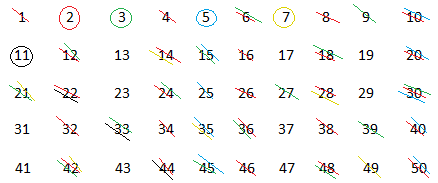

The numbers that are circled and not crossed out are the prime numbers. There are 15 prime numbers between 1 and 50.
Important observation:
The number 30 is crossed out by a blue, a red, and a green line. This means that 30 can be divided by 2, 3 and 5.
Therefore, the prime numbers less than 50 are 2, 3, 5, 7, 11, 13, 17, 19, 23, 29, 31, 37, 41, 43, and 47.
Prime number quiz
Take the quiz below to see how well you understand this lesson.

100 Tough Algebra Word Problems.
If you can solve these problems with no help, you must be a genius!
Recommended