Surface area of a rectangular prism
To derive the formula of the surface area of a rectangular prism, follow closely the steps below. Start with a right rectangular prism as shown below and call the length l, the width w, and the height h.
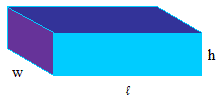
In order to make a rectangular prism like the one shown above, you basically use the following rectangular prism template:
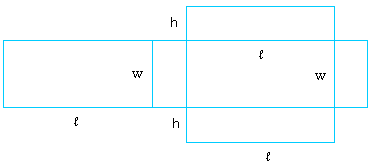
Looking at the rectangular prism template, it is easy to see that the solid has six sides and each side is a rectangle.
The bottom side and the top side are equal and have l and w as dimensions.
The area for the top and bottom sides is l × w + l × w = 2 × l × w
The front side (shown in sky blue) and the back side (not shown) are equal and have h and l as dimensions.
The area for the front and the back sides is l × h + l × h = 2 × l × h
Then, the left and right sides have h and w as its dimensions. One side is shown in purple.
The area for the left and the right sides is w × h + w × h = 2 × w × h
The total surface area, call it SA is:
SA = 2 × l × w + 2 × l × h + 2 × w × h
Examples showing how to find the surface area of a rectangular prism
Example #1:
Find the surface area of a rectangular prism with a length of 6 cm, a width of 4 cm, and a height of 2 cm.
SA = 2 × l × w + 2 × l × h + 2 × w × h
SA = 2 × 6 × 4 + 2 × 6 × 2 + 2 × 4 × 2
SA = 48 + 24 + 16
SA = 88 cm2
Example #2:
Find the surface area of a rectangular prism with a length of 4 cm, a width of 5 cm, and a height of 10 cm.
SA = 2 × l × w + 2 × l × h + 2 × w × h
SA = 2 × 4 × 5 + 2 × 4 × 10 + 2 × 5 × 10
SA = 40 + 80 + 100
SA = 220 cm2
Example #3:
Find the surface area with a length of 1/2 cm, a width of 8 cm, and a height of 1/4 cm.
SA = 2 × l × w + 2 × l × h + 2 × w × h
SA = 2 × 1/2 × 8 + 2 × 1/2 × 1/4 + 2 × 8 × 1/4
SA = 1 × 8 + 1 × 1/4 + 16 × 1/4
SA = 8 + 1/4 + 4
SA = 12 + 1/4
SA = 48/4 + 1/4
SA = 49/4 cm2
SA = 12.25 cm2

100 Tough Algebra Word Problems.
If you can solve these problems with no help, you must be a genius!

Recommended