Earnings Word Problems
How much will I earn this week? How many hours did I work? How much do I need to earn to save $500 a month? Earnings word problems answer questions like these. Almost all of them are built from three ideas: a fixed amount plus an amount for each unit, a percent of a number, and time and a half for overtime.
In this lesson, you will learn
- How to work with a fixed amount plus an amount per unit
- How to find gross earnings with a base salary and a commission
- How to find overtime pay, and the regular rate from the total pay
- How to find an income from the percent that is saved
A Fixed Amount Plus an Amount per Unit
Many prices and paychecks have two parts: an amount you pay or earn once, and an amount for each item, hour or month. The total is always:
- The cost of the enlargements is n × $10 = 10n.
- Total cost = sitting fee + cost of enlargements, so 50 + 10n = 180.
- Subtract 50 from both sides: 10n = 130.
- Divide both sides by 10: n = 13.
The customer ordered 13 enlargements.
Check: 13 × $10 = $130, and $50 + $130 = $180.
A plumber charges $60 to come to your home plus $45 per hour. A repair cost $240. How many hours did the plumber work?
Show answer
60 + 45h = 240, so 45h = 180 and h = 4 hours.
Base Salary Plus Commission
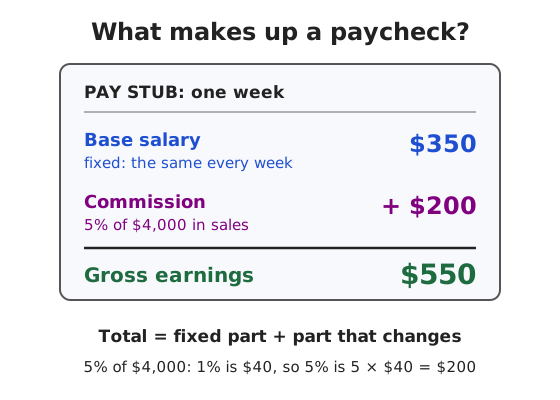
A commission is a percent of the sales a person makes. Salespeople often earn a base salary plus a commission. Their gross earnings are the total before taxes:
- Commission: 5% of $4,000 = 5100 × 4,000 = 20,000100 = $200.
- Gross earnings: $350 + $200 = $550.
Bryan's gross earnings for the week are $550.
To find a percent of a number quickly, find 1% first by dividing by 100. 1% of $4,000 is $40, so 5% is 5 × $40 = $200.
Ana earns $300 a week plus a 4% commission on her sales. Her sales this week were $6,000. What are her gross earnings?
Show answer
Commission: 4% of $6,000 = $240. Gross earnings: $300 + $240 = $540.
Overtime: Time and a Half
Many workers are paid time and a half for hours over 40 hours a week. The overtime rate is 1½ times the regular rate: the regular rate plus half of it. If the regular rate is $16 an hour, the overtime rate is $16 + $8 = $24 an hour.
For example, at $16 an hour, 45 hours of work pays 40 × $16 + 5 × $24 = $640 + $120 = $760.
Sometimes you know the total pay and need the regular rate. Then use a variable.
- Let x be her regular hourly rate. Her overtime rate is x + x2 = 1.5x.
- She worked 52 − 40 = 12 overtime hours.
- Regular pay: 40x. Overtime pay: 12 × 1.5x = 18x.
- Gross pay: 40x + 18x = 667, so 58x = 667.
- x = 667 ÷ 58 = 11.50.
Alice's regular hourly rate is $11.50.
Check: the overtime rate is $11.50 + $5.75 = $17.25. 40 × $11.50 + 12 × $17.25 = $460 + $207 = $667.
Only the hours over 40 are paid at time and a half. For 52 hours, Alice gets the overtime rate for 12 hours, not for all 52.
Income, Spending and Savings
When a problem tells you what percent of an income is spent, the rest is saved. If you know how much is saved, you can find the whole income.
- He spends 20% + 15% + 15% + 30% = 80% of his income.
- So he saves 100% − 80% = 20% of his income.
- Let x be his monthly income. 20% of x is Rs 2,500: 0.2x = 2,500.
- x = 2,500 ÷ 0.2 = Rs 12,500 per month.
- His yearly income is 12 × Rs 12,500 = Rs 150,000.
The man's yearly income is Rs 150,000.
The savings here are per month, so 20% of the monthly income is Rs 2,500. Find the monthly income first, then multiply by 12 for the year.
Sam saves 25% of his monthly income. He saves $800 a month. What is his monthly income?
Show answer
25% of his income is $800, so 1% is $32 and 100% is $3,200.
Summary
- Total = fixed amount + amount per unit × number of units. To find the number of units, subtract the fixed amount, then divide.
- Gross earnings = base salary + commission, and the commission is a percent of the sales.
- Time and a half pays 1.5 times the regular rate, but only for the hours over 40.
- To find an income from the savings, find the percent saved, then find 1% and 100%.
- Always check your answer by putting it back into the story.
Interactive Practice: Solve 5 Earnings Word Problems
Now solve some problems yourself. Problems 1 and 2 walk you through every step. Problem 3 has fewer steps. In problems 4 and 5, you follow the key steps and find every answer yourself. Type whole numbers only. You can skip a problem at any time, and each time you play you get new problems.
Practice Complete!