Fractions in Recipes: How to Scale a Recipe Up or Down
Recipes are one of the most common places where people use fractions every day. A cup of flour, 12 teaspoon of salt, 34 cup of sugar: almost every recipe is written with fractions. And as soon as you want to make more or less food than the recipe makes, you need to multiply those fractions.
In this lesson, you will learn
- How to find the scale factor that tells you how much bigger or smaller to make a recipe
- How to multiply fractions and mixed numbers to get the new amount of each ingredient
- How to make a smaller batch, such as half or two-thirds of a recipe
- How to turn your answers into amounts you can measure with cups and spoons
Why Recipes Are Full of Fractions
Measuring cups and spoons come in fractions: 1 cup, 12 cup, 13 cup, 14 cup, and spoons of 1 tablespoon, 1 teaspoon, 12 teaspoon and 14 teaspoon. That is why recipes use amounts like 34 cup of milk or 2 14 cups of flour.
A recipe also tells you how much food it makes, for example 8 muffins or 4 servings. If you want 20 muffins instead of 8, you cannot just guess. You need to change every ingredient by the same amount, or the muffins will come out too dry, too sweet or too salty. Fractions make this possible.
Step 1: Find the Scale Factor
The scale factor is the number you multiply every ingredient by. It tells you how many times bigger or smaller your batch is than the recipe.
Here are some examples:
- The recipe makes 8 muffins and you want 16: 168 = 2. You double the recipe.
- The recipe makes 8 muffins and you want 4: 48 = 12. You make half of the recipe.
- The recipe makes 16 brownies and you want 24: 2416 = 32 = 1 12. You make one and a half times the recipe.
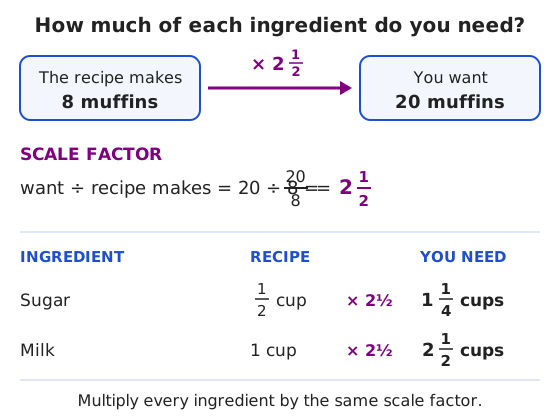
- The recipe makes 8 muffins and you want 20: 208 = 52 = 2 12.
A scale factor greater than 1 makes a bigger batch. A scale factor less than 1 makes a smaller batch. Keep the scale factor as a fraction: 52 is easier to multiply with than 2.5.
A recipe makes 12 pancakes. What is the scale factor if you want 18 pancakes?
Show answer
32, or 1 12. 1812 = 32, so you make one and a half times the recipe.
Step 2: Multiply Each Ingredient to Make a Bigger Batch
Multiply every ingredient by the scale factor. To multiply fractions, multiply the numerators and multiply the denominators. Change a mixed number into an improper fraction first.
- Find the scale factor: 208 = 52.
- Multiply each ingredient by 52. For the sugar: 12 × 52 = 54 = 1 14 cups.
- For the flour: 2 × 52 = 102 = 5 cups.
- Do the same for every ingredient:
| Ingredient | For 8 muffins | × 52 | For 20 muffins |
|---|---|---|---|
| Flour | 2 cups | 102 | 5 cups |
| Milk | 1 cup | 52 | 2 12 cups |
| Sugar | 12 cup | 54 | 1 14 cups |
| Oats | 14 cup | 58 | 58 cup |
| Salt | 14 teaspoon | 58 | 58 teaspoon |
Maryse needs 5 cups of flour, 2 12 cups of milk, 1 14 cups of sugar, 58 cup of oats and 58 teaspoon of salt.
When an amount is a mixed number, change it into an improper fraction before you multiply.
- Find the scale factor: 11228 = 4.
- Change the mixed number into an improper fraction: 4 14 = 174.
- Multiply: 174 × 4 = 684 = 17.
You need 17 cups of flour.
A recipe needs 23 cup of milk for 4 servings. How much milk do you need for 6 servings?
Show answer
1 cup. The scale factor is 64 = 32, and 23 × 32 = 66 = 1.
Making a Smaller Batch
To make less food, use the same steps. The scale factor is now less than 1, so every amount gets smaller.
- Find the scale factor: 816 = 12. You are making half of the recipe.
- Multiply: 13 × 12 = 16.
You need 16 cup of nuts.
Sometimes a recipe tells you directly what fraction to make.
- The scale factor is 23.
- Change the mixed number into an improper fraction: 4 12 = 92.
- Multiply: 92 × 23 = 186 = 3.
Alison will use 3 cups of sugar.
What is half of 34 cup?
Show answer
38 cup. 34 × 12 = 38. To halve a fraction, double its denominator.
Turning Your Answer into Cups and Spoons
An answer like 58 cup is correct, but most kitchens do not have a 18 cup. You can measure it with the cups and spoons you have if you know these facts:
1 cup = 16 tablespoons, so 18 cup = 2 tablespoons and 14 cup = 4 tablespoons.
1 tablespoon = 3 teaspoons.
- 58 cup = 48 + 18 = 12 cup + 2 tablespoons.
- 1 14 cups = 1 cup + 14 cup.
- 38 cup = 14 cup + 2 tablespoons, or 6 tablespoons.
- 58 teaspoon = 12 teaspoon + 18 teaspoon, which is a small pinch.
How many tablespoons are in 34 cup?
Show answer
12 tablespoons. 34 × 16 = 12.
Common Mistakes When Scaling a Recipe
Adding instead of multiplying. Going from 8 muffins to 20 muffins is not "add 12 to everything". You multiply every ingredient by 208 = 2 12.
Halving the denominator. Half of 34 cup is 38 cup, not 32 cup. Dividing the denominator by 2 doubles the amount.
Multiplying only the whole number of a mixed number. Twice 2 14 cups is 4 12 cups, not 4 14 cups. Change the mixed number into an improper fraction first: 94 × 2 = 184 = 4 12.
One tip from the kitchen: things you cannot split, like eggs, may need rounding. If 2 12 eggs is the answer, beat 3 eggs and leave out a little, or use 2 large eggs.
Summary
- The scale factor is the amount you want divided by the amount the recipe makes.
- Multiply every ingredient by the same scale factor. A scale factor greater than 1 makes more food; less than 1 makes less food.
- To multiply, change mixed numbers into improper fractions, multiply the numerators and the denominators, then simplify.
- Turn the answer into measurable amounts: 1 cup = 16 tablespoons and 1 tablespoon = 3 teaspoons.
- Never add the same amount to every ingredient, and never halve a fraction by halving its denominator.
Interactive Practice: Scale 5 Recipes with Fractions
Now scale some recipes yourself. Problems 1 and 2 walk you through every step. Problem 3 has fewer steps. In problems 4 and 5, you follow the key steps and find every answer yourself. You can skip a problem at any time, and each time you play you get new recipes.
Practice Complete!