Similar and Dissimilar Fractions
Fractions that have the same denominator are called similar fractions, and fractions that have different denominators are called dissimilar fractions. Knowing which kind you have tells you what to do before you add, subtract, or compare them.
In this lesson, you will learn
- How to tell similar fractions from dissimilar fractions
- How to change dissimilar fractions into similar fractions
- How to compare, add, and subtract similar and dissimilar fractions
- Why multiplying works the same way for both kinds
What Are Similar and Dissimilar Fractions?
Similar fractions (also called like fractions) are fractions that have the same denominator.
Dissimilar fractions (also called unlike fractions) are fractions that have different denominators.
For example, 14, 34, and 54 are similar fractions because they all have the denominator 4.
12, 13, and 35 are dissimilar fractions because their denominators, 2, 3, and 5, are different.
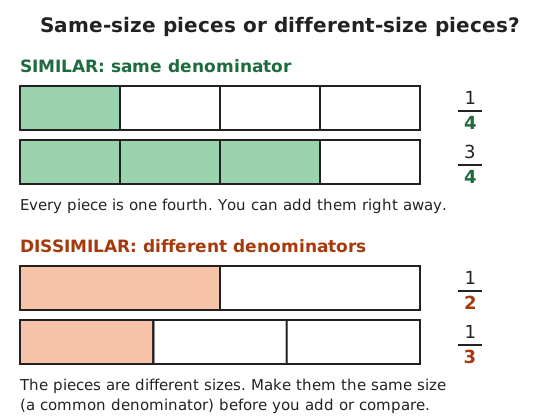
The denominator tells you the size of each piece. Similar fractions are made of pieces of the same size, so you can add, subtract, or compare them right away. Dissimilar fractions are made of pieces of different sizes, so you first cut them into pieces of the same size.
Look only at the denominators. The numerators do not matter when you decide whether fractions are similar or dissimilar.
Equal fractions are not always similar fractions. 12 and 24 are equal, but they are dissimilar because their denominators, 2 and 4, are different.
Are 29 and 79 similar or dissimilar fractions?
Show answer
Similar. Both fractions have the denominator 9.
How to Change Dissimilar Fractions into Similar Fractions
To change dissimilar fractions into similar fractions, rewrite each fraction with the same denominator. The best denominator to use is the least common denominator (LCD), which is the least common multiple of the denominators.
Multiply the numerator and the denominator of a fraction by the same number. The fraction keeps the same value, but its denominator changes.
- Find the LCD of 3 and 4. The multiples of 3 are 3, 6, 9, 12, … and the multiples of 4 are 4, 8, 12, … The LCD is 12.
- 3 × 4 = 12, so multiply the top and the bottom of 23 by 4: 2 × 43 × 4 = 812.
- 4 × 3 = 12, so multiply the top and the bottom of 34 by 3: 3 × 34 × 3 = 912.
23 and 34 become the similar fractions 812 and 912.
Change 16 and 38 into similar fractions.
Show answer
424 and 924. The LCD of 6 and 8 is 24. Multiply 16 by 44 and 38 by 33.
Comparing Similar and Dissimilar Fractions
When fractions are similar, the pieces are the same size, so the fraction with the bigger numerator is the bigger fraction. For example, 58 > 38 because 5 > 3.
When fractions are dissimilar, change them into similar fractions first, then compare the numerators.
- The fractions are dissimilar. The LCD of 6 and 9 is 18.
- 56 = 1518 and 79 = 1418.
- Compare the numerators: 15 > 14.
56 is bigger than 79.
You can learn more ways to do this in the lesson on comparing fractions.
Which is bigger, 34 or 45?
Show answer
45. With the LCD 20, 34 = 1520 and 45 = 1620, and 16 > 15.
Adding and Subtracting Similar and Dissimilar Fractions
To add or subtract similar fractions, add or subtract the numerators and keep the denominator. Simplify the answer if you can.
For example, 27 + 37 = 57 and 710 − 310 = 410 = 25.
To add or subtract dissimilar fractions, change them into similar fractions first.
- The fractions are dissimilar. The LCD of 4 and 6 is 12.
- 34 = 912 and 16 = 212.
- Add the numerators and keep the denominator: 912 + 212 = 1112.
34 + 16 = 1112
- The LCD of 6 and 4 is 12.
- 56 = 1012 and 14 = 312.
- Subtract the numerators: 1012 − 312 = 712.
56 − 14 = 712
Never add the denominators. 12 + 13 is not 25. With the LCD 6, it is 36 + 26 = 56.
Add 25 + 13.
Show answer
1115. The LCD of 5 and 3 is 15: 615 + 515 = 1115.
Multiplying Similar and Dissimilar Fractions
Multiplying is different. You do not need a common denominator, so you multiply similar and dissimilar fractions in exactly the same way.
To multiply fractions, multiply the numerators, multiply the denominators, and simplify the answer.
Similar fractions: 25 × 35 = 2 × 35 × 5 = 625.
Dissimilar fractions: 23 × 34 = 2 × 33 × 4 = 612 = 12.
A whole number is a fraction with the denominator 1. For example, 16 × 3 = 16 × 31 = 36 = 12.
When you multiply similar fractions, do not keep the denominator the way you do when you add. 25 × 35 is 625, not 65.
Dividing also works the same way for both kinds: multiply the first fraction by the reciprocal of the second. See multiplying fractions for more examples.
Multiply 34 × 29.
Show answer
16. 3 × 24 × 9 = 636 = 16. No common denominator is needed.
Summary
- Similar (like) fractions have the same denominator. Dissimilar (unlike) fractions have different denominators.
- To change dissimilar fractions into similar fractions, rewrite each one with the least common denominator.
- To compare similar fractions, compare the numerators. Change dissimilar fractions into similar fractions first.
- To add or subtract, the fractions must be similar. Add or subtract the numerators and keep the denominator.
- To multiply or divide, it does not matter whether the fractions are similar or dissimilar.
Test Yourself: Interactive 10-Question Quiz
Now check what you learned. Every answer is explained, and each time you play you get new questions.
Quiz Complete!
Keep learning