System of Equations Word Problems
Many word problems have two unknown numbers: how many adult and child tickets were sold, how much a CD and a book cost, how many $1 and $5 bills are in a wallet. When a problem gives you two facts about two unknowns, you can write one equation for each fact and solve the system of linear equations. This lesson shows you how, with every common type of problem.
In this lesson, you will learn
- A four-step plan to turn a word problem into a system of two equations
- How to solve problems with two kinds of items, prices and totals
- How to handle "more than", "times as much", sharing and ratio problems
- When to use substitution and when to use elimination
How to Solve a System of Equations Word Problem
Every problem in this lesson is solved with the same four steps.
1. Name the unknowns. Write what x and y stand for, for example "x = the number of $1 bills".
2. Write one equation for each fact. Two unknowns need two facts. Often one fact tells you how many and the other tells you how much.
3. Solve the system with substitution or elimination.
4. Check and answer. Put the numbers back into the story and answer the question that was asked.
Use the substitution method when one equation already says what x or y is, such as y = x + 10 or x = 3y. Use the elimination method when both equations look like ax + by = c.
Two Kinds of Items: How Many and How Much
This is the most common type. The problem tells you the total number of items and the total value, number of bedrooms or cost.
- Let x be the number of apartments with 1 bedroom and y be the number of apartments with 2 bedrooms.
- How many apartments: x + y = 50 (1). How many bedrooms: x + 2y = 80 (2).
- Use equation (1) to solve for x: x = 50 − y.
- Replace x in equation (2): 50 − y + 2y = 80, so 50 + y = 80 and y = 30.
- x = 50 − 30 = 20.
20 apartments have 1 bedroom and 30 apartments have 2 bedrooms.
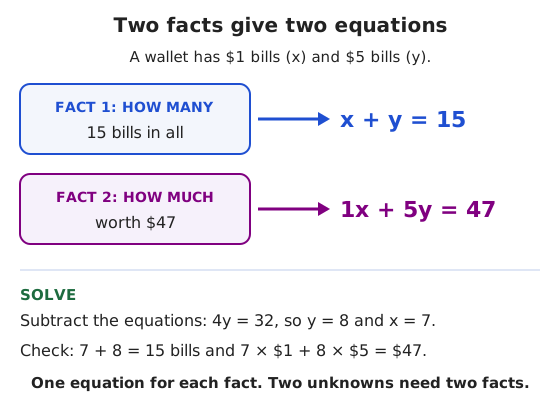
The same idea works with money. A student has some $1 bills and $5 bills in his wallet. He has a total of 15 bills that are worth $47. How many of each type of bill does he have?
- Let x be the number of $1 bills and y be the number of $5 bills.
- How many bills: x + y = 15 (1). How much money: 1x + 5y = 47 (2).
- Both equations start with x, so subtract equation (1) from equation (2): 4y = 32, so y = 8.
- x + 8 = 15, so x = 7.
The student has seven $1 bills and eight $5 bills.
Here is a quick one with food. A burger place sells burgers for $4 and fries for $2. Bob bought 6 items for a total of $18. Let b be the number of burgers and f be the number of fries: b + f = 6 and 4b + 2f = 18. From the first equation, b = 6 − f. Then 4(6 − f) + 2f = 18, so 24 − 2f = 18 and f = 3. Bob bought 3 burgers and 3 orders of fries.
When the prices are in cents, clear the decimals first.
- Let x be the number of full cups and y be the number of half cups.
- How many cups: x + y = 37 (1). How much money: 0.50x + 0.25y = 17 (2).
- Multiply equation (2) by 4 to clear the decimals: 2x + y = 68 (3).
- Subtract equation (1) from equation (3): x = 31.
- 31 + y = 37, so y = 6.
They sold 31 full cups and 6 half cups of lemonade.
Mixing up the count and the value. The equation for "how many" adds the numbers of items (x + y = 15). The equation for "how much" multiplies each number of items by its value (1x + 5y = 47).
A theater sold 40 tickets. Adult tickets cost $8 and child tickets cost $5. The theater made $260. How many adult tickets were sold?
Show answer
20 adult tickets. a + c = 40 and 8a + 5c = 260. Multiply the first equation by 5: 5a + 5c = 200. Subtract: 3a = 60, so a = 20 and c = 20.
When One Amount Is More Than the Other
Sometimes the second fact compares the two unknowns, such as "10 more than". That fact gives an equation like y = x + 10, which is perfect for substitution.
- Let x be the number of transactions by local account holders and y be the number by international account holders.
- How much money: 11x + 26y = 1185 (1). The comparison: y = x + 10 (2).
- Substitute x + 10 for y in equation (1): 11x + 26(x + 10) = 1185.
- 11x + 26x + 260 = 1185, so 37x = 925 and x = 25.
- y = 25 + 10 = 35.
There were 25 + 35 = 60 ATM transactions: 25 by local and 35 by international account holders.
A class has 4 more girls than boys. There are 30 students. How many boys are there?
Show answer
13 boys. g = b + 4 and b + g = 30, so b + b + 4 = 30, 2b = 26 and b = 13. There are 17 girls.
Two Purchases with the Same Prices
Andrew had $93. With this money, he could buy 3 CDs and 4 books. However, he bought only 2 CDs and 3 books and had $27 left. What was the cost of each CD?
- Let x be the cost of 1 CD and y be the cost of 1 book.
- First purchase: 3x + 4y = 93 (1). Second purchase: he had $27 left, so he spent 93 − 27 = 66 dollars: 2x + 3y = 66 (2).
- Make the x terms opposites. Multiply equation (1) by −2 and equation (2) by 3: −6x − 8y = −186 and 6x + 9y = 198.
- Add the two equations: y = 12.
- Use equation (2) to find x: 2x + 3 × 12 = 66, so 2x = 30 and x = 15.
Each CD costs $15 and each book costs $12.
Check: 3 × 15 + 4 × 12 = 45 + 48 = 93 and 2 × 15 + 3 × 12 = 30 + 36 = 66.
2 pens and 1 notebook cost $7. 1 pen and 3 notebooks cost $11. How much does a notebook cost?
Show answer
$3. 2p + n = 7 and p + 3n = 11. Multiply the second equation by 2: 2p + 6n = 22. Subtract the first: 5n = 15, so n = 3 and p = 2.
Times as Much, Before and After a Change
Bessy has 6 times as much money as Bob. But when each earns $6, Bessy will have 3 times as much money as Bob. How much does each have before and after earning the $6?
Here the first fact already tells you Bessy's money in terms of Bob's, so you only need one variable. You could also write y = 6x and y + 6 = 3(x + 6) and use substitution: it is the same equation.
- Let x be Bob's money. Bessy's money is 6x.
- After earning $6, Bob has x + 6 and Bessy has 6x + 6.
- Bessy then has 3 times as much as Bob: 6x + 6 = 3(x + 6), so 6x + 6 = 3x + 18.
- Subtract 3x and 6 from both sides: 3x = 12, so x = 4.
Before: Bob had $4 and Bessy had 6 × 4 = $24. After: Bob had $10 and Bessy had $30. Indeed, 30 is 3 times 10.
Adding the $6 to only one person. Both people earn $6, so add 6 to both amounts. The same idea is used in age word problems, where everyone gets older by the same number of years.
Sharing an Amount
A certain amount of money will be shared equally among 24 students. If 6 students don't come, each student will receive $300 more. Find the amount of money.
- Let x be the amount of money and y be the amount each student gets.
- Shared among 24 students: x24 = y, so x = 24y (1).
- Shared among 24 − 6 = 18 students, each gets $300 more: x18 = y + 300, so x = 18y + 5400 (2).
- Replace x in equation (2): 24y = 18y + 5400, so 6y = 5400 and y = 900.
- x = 24 × 900 = 21,600.
The amount of money is $21,600.
Check: 21,600 ÷ 24 = 900 and 21,600 ÷ 18 = 1,200. 1,200 − 900 = 300, so each student does get $300 more.
Ratios with Three Unknowns
A man bought 66 kg of three types of fruit: bananas, oranges and apples. The ratio of bananas to oranges is 4 : 5 and the ratio of oranges to apples is 2 : 3. How many kilograms of apples did he buy?
- Let x, y and z be the kilograms of bananas, oranges and apples: x + y + z = 66.
- xy = 45, so 5x = 4y and x = 4y5.
- yz = 23, so 2z = 3y and z = 3y2.
- Replace x and z: 4y5 + y + 3y2 = 66. With the denominator 10: 8y + 10y + 15y10 = 66, so 33y = 660 and y = 20.
- z = 3 × 202 = 30 and x = 4 × 205 = 16.
He bought 30 kg of apples (and 16 kg of bananas and 20 kg of oranges).
To review ratios, see ratio word problems.
Percent Increase Problems
There are two bags of marbles. If 100 marbles from the first bag are placed in the second bag, the number in the second bag increases by 50%. If 100 marbles from the second bag are placed in the first bag, the number in the first bag increases by 40%. How many marbles are there?
- Let x be the number of marbles in the first bag and y the number in the second bag.
- Adding 100 to the second bag increases it by 50%: y + 100 = y + 0.50y, so 100 = 0.50y and y = 200.
- Adding 100 to the first bag increases it by 40%: x + 100 = x + 0.40x, so 100 = 0.40x and x = 250.
There are 250 + 200 = 450 marbles in all.
Each fact here only talks about one bag, so each equation has only one unknown. You still need both facts to answer the question.
Summary
- Two unknowns need two facts. Write one equation for each fact.
- In "two kinds of items" problems, one equation counts the items (x + y = total) and the other adds their values (ax + by = total value).
- A comparison such as "10 more" or "6 times as much" gives an equation that is ready for substitution.
- When both equations look like ax + by = c, use elimination: multiply to make one variable cancel, then add or subtract.
- Always check your numbers in the story and answer the exact question that was asked.
Interactive Practice: Solve 5 System of Equations Word Problems
Now solve some problems yourself. Problems 1 and 2 walk you through every step. Problem 3 has fewer steps. In problems 4 and 5, you follow the key steps and find every answer yourself. You can skip a problem at any time, and each time you play you get new problems.
Practice Complete!