Fraction of a Fraction Word Problems
Many word problems take a fraction of something that is already a fraction: half of 56 of a pizza, 13 of your part of a job, 14 of the remaining cupcakes. These are fraction of a fraction word problems. They all use the same two tools: multiply to find the part, then subtract to find what is left.
In this lesson, you will learn
- Why "a fraction of a fraction" means you multiply
- The difference between a fraction of the whole and a fraction of the remaining part
- How to find what is left after one or more steps
- How to work backwards to find the starting amount
Why "Of" Means Multiply
Half of 10 is 12 × 10 = 5. In the same way, half of 56 is 12 × 56. In math, the word "of" after a fraction tells you to multiply.
To find a fraction of a fraction, multiply the numerators and multiply the denominators, then simplify: ab of cd = ab × cd = a × cb × d.
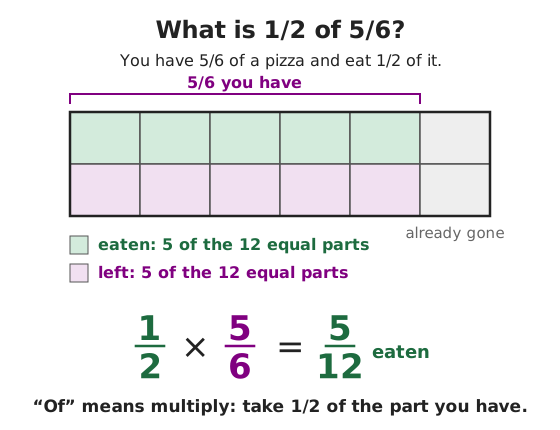
- I eat 12 of 56: 12 × 56 = 1 × 52 × 6 = 512.
- To find what is left, subtract what I ate from what I had: 56 − 512.
- Use the common denominator 12: 1012 − 512 = 512.
I eat 512 of the pizza, and 512 of the pizza is left.
The answer makes sense: eating half of what you have leaves the other half, and both halves are 512.
What is 23 of 34?
Show answer
23 × 34 = 612 = 12.
A Fraction of Your Part
Sometimes the first fraction is your share of a job, and someone takes a fraction of your share. The question usually asks for a fraction of the entire job.
- Your friend sweeps 13 of 34: 13 × 34 = 312 = 14 of the floor.
- Your part was 34. Subtract what your friend sweeps: 34 − 14 = 24 = 12.
Your friend sweeps 14 of the floor, and you sweep 12 of the floor.
Here is another way to see it. Your part, 34, is three pieces of 14: 14 + 14 + 14. Your friend takes one of the three pieces, which is 14 of the floor, and you are left with 14 + 14 = 12.
23 of a garden is vegetables. Tomatoes grow on 12 of the vegetable part. What fraction of the whole garden is tomatoes?
Show answer
12 × 23 = 26 = 13 of the garden.
A Fraction of the Remaining Part
Watch for the words "of the remaining" or "of the rest". They mean the second fraction is not a fraction of the whole. First find the remaining part, then take the fraction of it.
- After Ms. Clark, the remaining part is 1 − 13 = 33 − 13 = 23.
- Mackenzie iced 14 of 23: 14 × 23 = 212 = 16.
- Together they iced 13 + 16 = 26 + 16 = 36 = 12.
- The cupcakes with no icing: 1 − 12 = 12.
A. Mackenzie iced 16 of the cupcakes. B. 12 of the cupcakes have no icing.
Mackenzie did not ice 14 of the whole batch. She iced 14 of the 23 that was left, which is only 16 of the batch. If you use 14 of the whole, you get the wrong answer.
The same idea works with money. Johnny works at a bakery. A tray of brownies costs $10. Customer #1 buys 12 of the tray, so he pays 12 × $10 = $5. Customer #2 buys 14 of the remaining brownies. The remaining part is 12 of the tray, so Customer #2 buys 14 × 12 = 18 of the tray and pays 18 × $10 = $1.25.
Ana read 14 of a book on Monday. On Tuesday, she read 13 of the remaining pages. What fraction of the book did she read on Tuesday?
Show answer
The remaining part is 1 − 14 = 34. On Tuesday she read 13 × 34 = 312 = 14 of the book.
A Shortcut: Multiply by What Is Left
If 13 of something is taken away, 23 of it is left. So instead of finding each part and subtracting, you can multiply by the fraction that is left at every step.
- After the book, 23 of the money is left.
- After lunch, 34 of that is left.
- Money left: $120 × 23 × 34 = $120 × 612 = $120 × 12 = $60.
Tom has $60 left.
Check it step by step: the book costs 13 × $120 = $40, leaving $80. Lunch costs 14 × $80 = $20, leaving $60.
"Of the remaining" makes the fractions multiply, not add. Spending 13 and then 14 of the rest is not the same as spending 13 + 14 of the money.
Work Backwards to the Starting Amount
Some problems tell you how much is left at the end and ask how much there was at the start. Use a letter for the starting amount and find what fraction of it is left.
- Ricky ate 14, so 34 of n is left.
- Carl ate 13 of the remaining candies, so 23 of that is left: 23 × 34 = 612 = 12 of n.
- Jerome ate 15 of the remaining candies, so 45 of that is left: 45 × 12 = 410 = 25 of n.
- The candies left make 4 groups of 10, which is 40 candies. So 25 of n = 40.
- If 25 of n is 40, then 15 of n is 20, and n = 5 × 20 = 100.
They had 100 candies at first.
Check: Ricky eats 14 of 100 = 25, leaving 75. Carl eats 13 of 75 = 25, leaving 50. Jerome eats 15 of 50 = 10, leaving 40. And 40 candies make 4 groups of 10.
After spending 12 of her money and then 13 of the rest, Lea has $30 left. How much did she have at first?
Show answer
12 is left after the first step, then 23 of that: 23 × 12 = 13 of her money. 13 of her money is $30, so she had $90.
Summary
- "A fraction of" something means multiply: ab of cd = ab × cd.
- Read carefully: a fraction of the whole is different from a fraction of the remaining part.
- For "of the remaining", find the remaining part first (1 minus the first fraction), then multiply.
- To find what is left, subtract the part from what you had, or multiply by the fraction that is left at each step.
- To find a starting amount, find what fraction of it is left, then divide the amount left by that fraction.
Interactive Practice: Solve 5 Fraction of a Fraction Word Problems
Now solve some problems yourself. Problems 1 and 2 walk you through every step. Problem 3 has fewer steps. In problems 4 and 5, you follow the key steps and find every answer yourself. Type fractions in lowest terms. You can skip a problem at any time, and each time you play you get new problems.
Practice Complete!