Length and Width of a Rectangle Word Problems
A rectangle word problem gives you two facts about a rectangle, such as its perimeter and how much longer it is than it is wide, and asks for the length and the width. The trick is always the same: write the length using the width, so that you have only one unknown.
In this lesson, you will learn
- How to write the length using the width
- How to find the length and width from the perimeter
- How to find them from the area, and why you keep only the positive answer
- How to find them when you know both the perimeter and the area
The Two Formulas You Need
For a rectangle with length l and width w:
The perimeter is the distance around the rectangle, such as the length of a fence. The area is the space inside, such as the size of a garden.
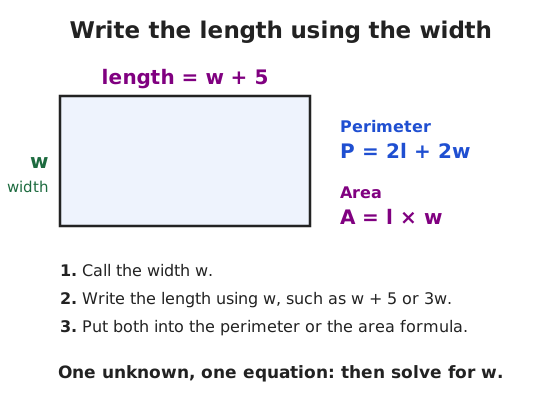
Let w be the width. Use the comparison in the problem to write the length with w: "5 more than the width" is w + 5, and "3 times the width" is 3w. Then put both into the perimeter or the area formula and solve for w.
Find the Length and Width from the Perimeter
- Let w be the width. The length exceeds the width by 65, so l = w + 65.
- Use P = 2l + 2w: 138 = 2(w + 65) + 2w.
- Multiply out: 138 = 2w + 130 + 2w = 4w + 130.
- Subtract 130 from both sides: 8 = 4w, so w = 2.
- l = 2 + 65 = 67.
The length is 67 inches and the width is 2 inches.
Check: 2 × 67 + 2 × 2 = 134 + 4 = 138, and 67 is 65 more than 2.
"Times" works the same way. If the length of a garden is 3 times its width and the perimeter is 48 meters, then l = 3w and 2(3w) + 2w = 8w = 48. So w = 6 meters and l = 18 meters.
The perimeter of a room is 50 feet. The length is 5 feet more than the width. Find the length and the width.
Show answer
2(w + 5) + 2w = 50, so 4w + 10 = 50, 4w = 40 and w = 10. The width is 10 feet and the length is 15 feet.
Find the Length and Width from the Area
When the fact is about the area, writing the length with w gives a quadratic equation: w is multiplied by itself.
- Let w be the width, so l = w + 5.
- Use A = l × w: (w + 5) × w = 24.
- Multiply out: w2 + 5w = 24.
- Subtract 24 from both sides: w2 + 5w − 24 = 0.
- Factor. Look for two numbers that multiply to −24 and add to 5: 8 and −3. So (w + 8)(w − 3) = 0.
- w + 8 = 0 gives w = −8, and w − 3 = 0 gives w = 3.
- A width cannot be negative, so w = 3 and l = 3 + 5 = 8.
The length is 8 and the width is 3.
The equation has two solutions, but a length or a width cannot be negative. Always throw away the negative solution and say why.
Check: 8 × 3 = 24, and 8 is 5 more than 3. To learn more about factoring equations like this one, see solving quadratic equations.
The area of a poster is 40 square inches. The length is 3 inches more than the width. Find the length and the width.
Show answer
(w + 3)w = 40, so w2 + 3w − 40 = 0 and (w + 8)(w − 5) = 0. The width is 5 inches and the length is 8 inches.
When You Know the Perimeter and the Area
Sometimes the problem gives the perimeter and the area, but no comparison. Divide the perimeter by 2 to get l + w. Then you need two numbers with that sum and with the area as their product.
- 2l + 2w = 24, so l + w = 12.
- l × w = 32.
- Which two numbers add up to 12 and multiply to 32? Try pairs: 2 and 10 (product 20), 3 and 9 (27), 4 and 8 (32).
The yard is 8 meters long and 4 meters wide.
With algebra: from l + w = 12, the length is l = 12 − w. Then (12 − w) × w = 32, which gives w2 − 12w + 32 = 0 and (w − 4)(w − 8) = 0. The two solutions, 4 and 8, are the two sides.
- The fence is the perimeter: 2l + 2w = 260, so l + w = 130.
- The area: l × w = 4,200.
- Replace l with 130 − w: (130 − w)w = 4,200, so w2 − 130w + 4,200 = 0.
- Factor: (w − 60)(w − 70) = 0, so the sides are 60 and 70.
The farmer should make the rectangle 70 meters long and 60 meters wide.
Check: 2 × 70 + 2 × 60 = 260 meters of fencing, and 70 × 60 = 4,200 square meters.
Summary
- Perimeter: P = 2l + 2w. Area: A = l × w.
- Let w be the width and write the length using w, such as w + 5 or 3w.
- With the perimeter, you get a linear equation: combine the w terms and solve.
- With the area, you get a quadratic equation: factor it and keep the positive solution.
- With both the perimeter and the area, find two numbers that add up to half the perimeter and multiply to the area.
Interactive Practice: Solve 5 Length and Width Word Problems
Now solve some problems yourself. Problems 1 and 2 walk you through every step. Problem 3 has fewer steps. In problems 4 and 5, you follow the key steps and find every answer yourself. You can skip a problem at any time, and each time you play you get new problems.
Practice Complete!