A Cartesian coordinate system, also known as rectangular coordinate system, is a set of two number lines that can be used to plot points and graph lines. The horizontal line is called x-axis and the vertical line is called y-axis.
A point is represented by a pair of numbers (x, y) and an example of a point is (1, 5). First start with the interactive lesson below.
Understanding the Four Quadrants
The coordinate grid is divided into four quadrants by the x and y axes. Each quadrant has different rules for the signs (+ or -) of x and y coordinates.
Quadrant 1 Point: (3, 2)
• x is positive (3 units right)
• y is positive (2 units up)
Remember: In Quadrant 1, both coordinates are positive (+,+)
Quadrant 2 Point: (-4, 3)
• x is negative (4 units left)
• y is positive (3 units up)
Remember: In Quadrant 2, x is negative and y is positive (-,+)
Quadrant 3 Point: (-2, -3)
• x is negative (2 units left)
• y is negative (3 units down)
Remember: In Quadrant 3, both coordinates are negative (-,-)
Quadrant 4 Point: (4, -2)
• x is positive (4 units right)
• y is negative (2 units down)
Remember: In Quadrant 4, x is positive and y is negative (+,-)
Explore the Coordinate System
Tap or click anywhere on the grid to place a point!
Find this point:
Current Point: (0, 0)
Quadrant: Origin
Score: 0 correct out of 0 attempts
How to plot points using vertical and horizontal lines
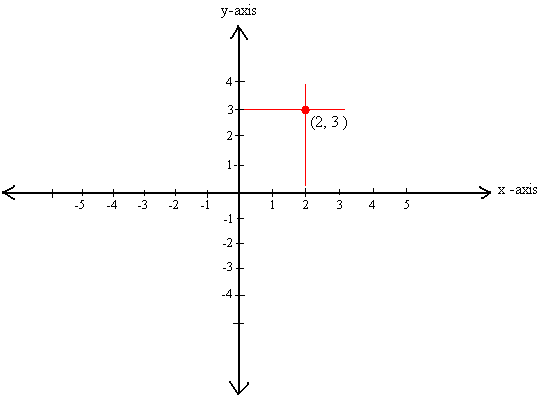
Locate point (2,3).
x = 2 and y = 3
Draw a vertical line at x = 2 and draw a horizontal line at y = 3
Where the two lines meet or intersect, is your point (in red)
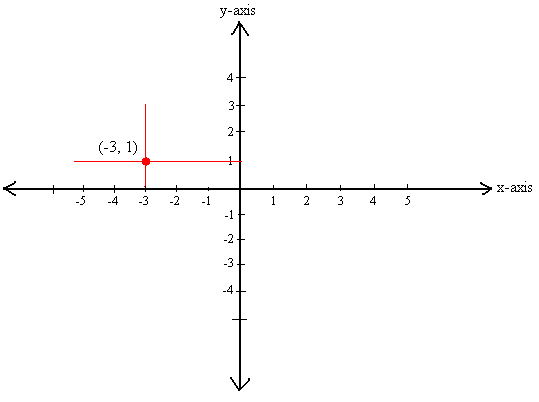
Locate point (-3, 1)
Draw a vertical line at x = -3 and draw a horizontal line at y = 1
The intersection of the two lines is your point.
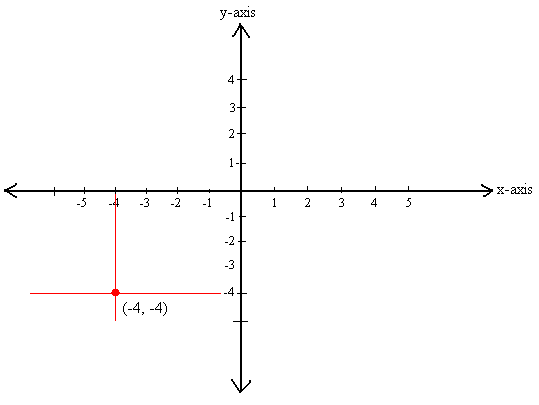
Locate point (-4, -4)
Draw a vertical line at x = -4 and draw a horizontal line at y = -4
Tricky cases are when points are located on the x-axis or the y-axis. Students usually get confused, so study the following two examples carefully.
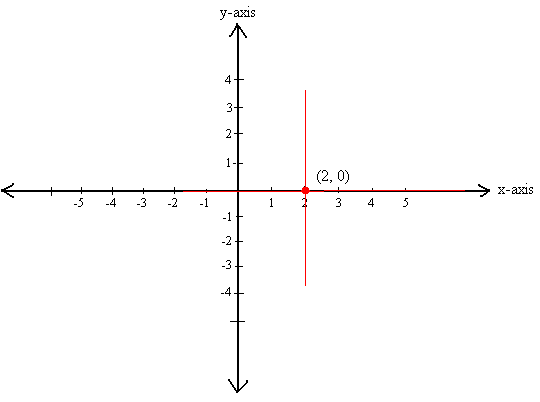
Locate point (2,0)
Draw a vertical line at x = 2 and draw a horizontal line at y = 0.
Notice that when y = 0, your horizontal line is on the x-axis
Important point to remember:
When y = 0, your point is always located on the x-axis
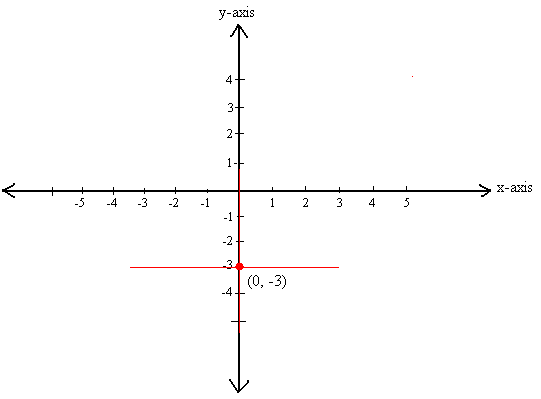
Locate point (0, -3)
Draw a vertical line at x = 0 and draw a horizontal line at y = -3.
Notice that when x = 0, your vertical line is on the x-axis
Important point to remember:
When x = 0, your point is always located on the y-axis