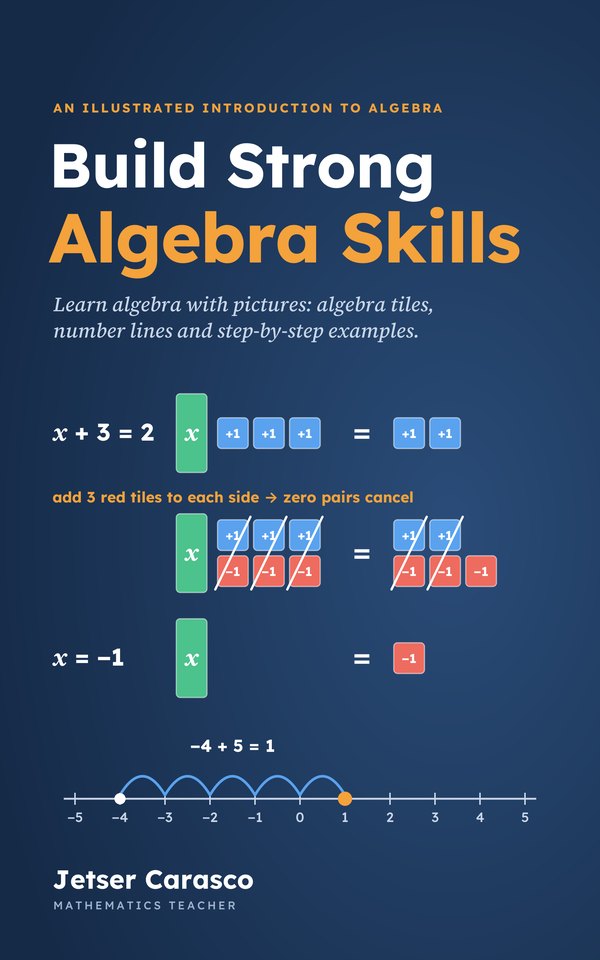
Build Strong Algebra Skills
An illustrated introduction to algebra
- Algebra tiles and number lines make each idea visual
- Start here if you are new to algebra, or use it to dig deeper
- Clear rule boxes, tips and step-by-step examples
Not sure where to start? These are the lessons and games we recommend most to students, parents and teachers on Basic-mathematics.com. Each lesson explains the topic in plain language, walks you through worked examples step by step, and ends with practice so you can check your understanding. Pick one below, or use the menu to find lessons on fractions, algebra, geometry, statistics and more.
Illustrated ebooks on algebra, fractions and geometry. Every idea is drawn first, then worked step by step, so it finally makes sense.
There are three kinds of fractions you need to know.
A proper fraction is a fraction that has a smaller numerator than denominator. It is always less than 1. The following are all proper fractions:
14 511 410 35 5060
Proper fractions are less than one whole circle.
An improper fraction is a fraction that has a numerator bigger than or equal to its denominator. It is equal to 1 or more. The following are all improper fractions:
65 72 21 53 115 44
Seven fourths fill one whole circle and three fourths of another.
A mixed number is a combination of a whole number and a proper fraction. The following are mixed numbers:
214 125 518 958
Notice that 214 means 2 and 14, or 2 + 14. Therefore, 214 is just a short way of writing 2 + 14.
There is a hidden addition sign between the whole number and the proper fraction of a mixed number.
The fraction part of a mixed number must be a proper fraction. For example, 352 is not a correctly written mixed number: since 52 = 212, it should be written 512.
Mixed numbers can be converted to improper fractions and vice versa. More on this is coming in the next lesson.
Pages from the book. The full ebook is a PDF you can read on any device.
The best way to tackle any integer problem with adding or subtracting is a number line. Put the first number on the number line and decide whether to move right or left.
| You see | Move |
|---|---|
| + positive | right |
| + negative | left |
| − positive | left |
| − negative | right |
In exercises 1 to 5 you move to the right. In exercises 6 to 9 you move to the left.
10) −221 + 200
Put −221 on the number line and move to the right. To get to 0, you would need to move 221 units. You only move 200, so you never reach 0 and the answer is negative.
Where are you on the negative side? How much is missing to get to 221? 200 + 21 = 221, so 21 is missing. You are at −21.
−221 + 200 = −21
11) −221 + (−200)
Put −221 on the number line and move to the left. You start on the negative side and keep moving away from 0, so the answer is negative. You move 221 + 200 = 421 units from 0 in all.
−221 + (−200) = −421
12) 350 + (−200)
Put 350 on the number line and move to the left. You only move 200 of the 350 units to 0, so you are still on the positive side, 350 − 200 = 150 units from 0.
350 + (−200) = 150
13) 350 + (−360)
After 350 units you are at 0, and any more moves take you to the negative side. You can still move 360 − 350 = 10 units, so you end up at −10.
350 + (−360) = −10
Pages from the book. The full ebook is a PDF you can read on any device.
Each chapter starts with formula cards. Every card has a clean, labelled drawing on one side and the formulas on the other, so you can find what you need in seconds.
After the cards come worked examples that show every step, then a short set of practice problems. All answers are at the back of the book, and a compact quick-reference section collects every formula in a few pages.
b is the base and h is the height.
Lengths are measured in units (cm, in, ft, m), areas in square units (cm², ft²) and volumes in cubic units (cm³, m³). Coloured boxes mark special notes:
The most important fact in a section.
A helpful way to think about a problem, or a shortcut.
An error many students make, and how to avoid it.
The reasoning behind a formula, so you can rebuild it if you forget it.
Cards marked NEW are formulas added in this edition.
Two angles that make a right angle together.
Two angles that make a straight line together.
Complementary goes with 90°, supplementary goes with 180°. A memory aid: C comes before S in the alphabet, and 90 comes before 180.
When two lines cross, the angles across from each other are called vertical angles.
Pages from the book. The full ebook is a PDF you can read on any device.
Each book pairs clear pictures with worked examples and practice, so students, parents and teachers can use it on their own.
An illustrated introduction to algebra
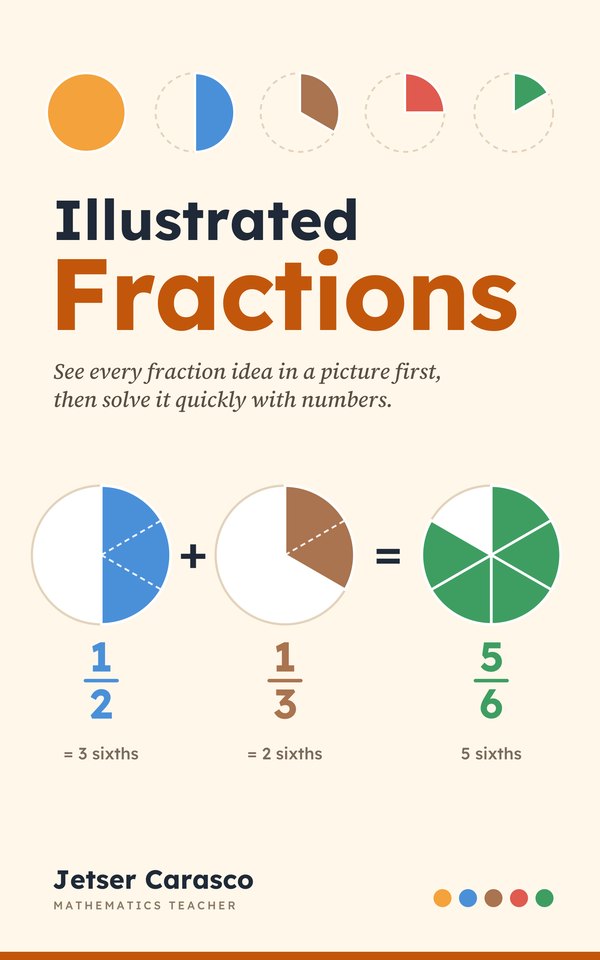
See every fraction idea in a picture first
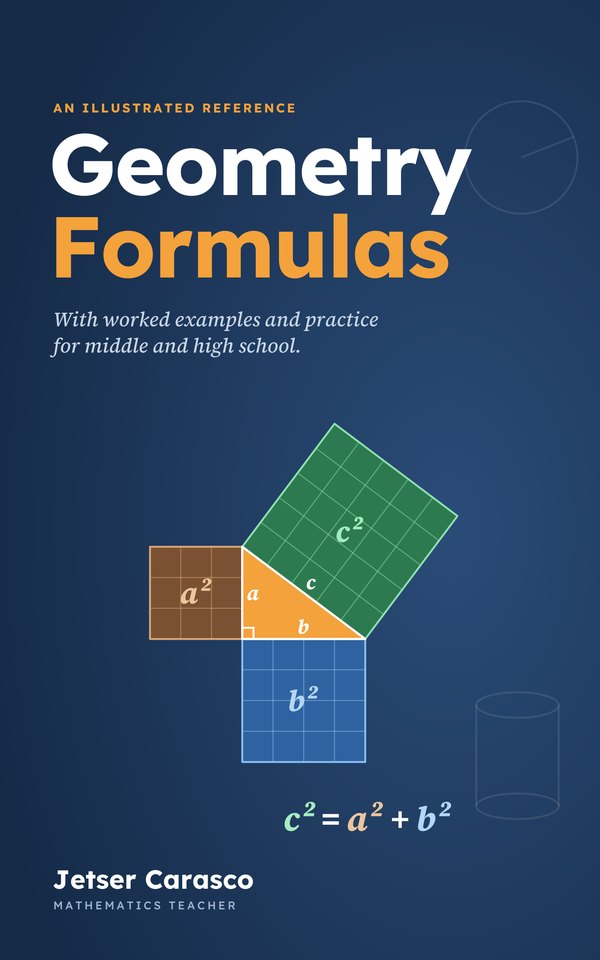
An illustrated reference for middle and high school
The tests are free on the site. Buy the solutions to check every answer and see how each problem is solved.
Solutions to tests covering the most important math skills taught in each grade.
Solutions to basic math, basic algebra, comprehensive algebra and basic geometry questions that test and strengthen core skills.
Learn how to solve 100 tough algebra word problems. If you can solve them all on your own, you are a genius.
Both tools are free to use on basic-mathematics.com. A membership adds the full features below.
Type a problem and see every step, with the answer checked by putting it back into the problem.
Practice for the GED Mathematical Reasoning test with high school level questions, then see your score and how each problem is solved.