Factoring Algebraic Expressions
Factoring algebraic expressions require a solid understanding of how to get the greatest common factor (GCF)I will not repeat the whole process here. Therefore, go here and review how to get the GCF before you start studying this lesson.
Basically, when factoring algebraic expressions, you will first look for the GCF and use your GCF to make your polynomial look like a multiplication problem:
GCF times( ) or GCF times( Blank )
where blank is a polynomial with the same amount of term as the original polynomial.
Recall that terms are separated by addition signs, never by multiplication sign.
A few examples about factoring algebraic expressions
Example #1:
Factor x2y4 + 2x2
This expression has two terms. The first term is x2y4 and the second is 2x2
What you see in bold is the GCF:x2 x2y4 + 2x2
So, we are going to make x2y4 + 2x2 look like:
x2 times ( )
Now you need to fill in the blank as shown below:
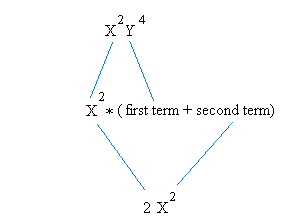
And whatever you multiply x2 to get 2x2 is your second term.
Therefore, x2y4 + 2x2 = x2(y4 + 2)
There is an easier way to solve the problem
x2y4 + 2x2
Still do x2 times ( )
Then, in the expression x2y4 + 2x2, take a pencil and cross out or erase the GCF x2.Then, whatever is left is your first and second term.
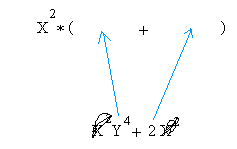
2)
8Y3B2 + 16Y2B
Rewrite the expression as: 8 × Y2 × Y × B × B + 8 × 2Y2B
Everything in bold is the GCF 8 × Y2 × Y × B × B + 8 × 2Y2B
The GCF is 8Y2B. The answer looks like 8Y2B × ( )
In the expression 8 × Y2 × Y × B ×B + 8 × 2Y2B, erase the GCF. Whatever is left is your first and second term.
The answer is 8 × Y2 × Y × B × B + 8 × 2Y2B = 8Y2B × (YB + 2)
3)
If instead you were factoring 8Y3B2 − 16Y2B, you will do the same thing with the exception that there will be a minus sign between the two terms. That is all!
8Y3B2 − 16Y2B = 8Y2B × (YB − 2)
4)
Factor 5(x-2) + 6x(x-2) Everything in bold is your GCF 5(x-2) + 6x(x-2)
So, (x-2) × ( 5 + 6x)