Scientific Notation
Interactive Scientific Notation Lesson
What is Scientific Notation?
Scientific notation expresses numbers in the form: a × 10n
where a is a number between 1 and 10, and n is an integer.
Example: 1,234 = 1.234 × 10³
Convert Your Number
Scientific Notation Quiz
Convert the following number to scientific notation (a × 10n)
Score: 0/0
Learn more about Scientific Notation
Scientific notation is a convenient way to deal with very large or very small numbers.
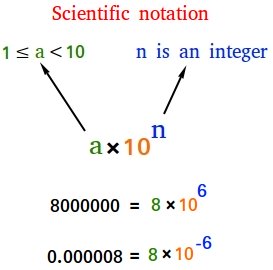
A number is in this format if we can write it as:
a × 10n
with 1 ≤ a < 10 and n is an integer.
1 ≤ a < 10 means that a is a number greater than or equal to 1, but less than 10.
Thus, a can be 1,2,3,4,5,6,7,8, and 9
a × 10n
with 1 ≤ a < 10 and n is an integer.
1 ≤ a < 10 means that a is a number greater than or equal to 1, but less than 10.
Thus, a can be 1,2,3,4,5,6,7,8, and 9
500 = 5 × 100 = 5 × 10²
You can also claim as we saw before that there is a decimal point after 0 and write 500.0
Then, move the decimal point 2 places to the left between 5 and 0 to get 5.000, which is the same as 5.
Since you moved it two places to the left, you know that your exponent is 2.
Your base is always 10
Thus, 500 = 5 × 10²
A few more examples showing how to convert a number into scientific notation.
Example #1: Convert 75000 into scientific notation.
75000 = 75000.0
Move the decimal point 4 places to the left between 7 and 5.
We get 7.5000, which is the same as 7.5
Since we moved it 4 places to the left, your exponent is 4 and your base is still 10.
Thus, 75000 = 7.5 × 10⁴
Sometimes, instead of moving your decimal point to the left, you have to move it to the right as the following example demonstrates:
When you move your decimal point to the right, your exponent is negative.
Example #2: 0.002
Move your decimal point 3 places to the right after the 2 to get 0002. and 0002. is the same as 2. or 2
Since you had to move it 3 places to the right, your exponent is -3 and the base is still 10
Thus, 0.002 = 2 × 10⁻³
Example #3: 0.000065
Move decimal point 5 places to the right
The answer is 6.5 × 10⁻⁵
Example #4: 650000
Move decimal point 5 places to the left
The answer is 6.5 × 10⁵