Surface area of a sphere
The surface area of a sphere is the total area of the curved surface of the sphere since the shape of a sphere is completely round.
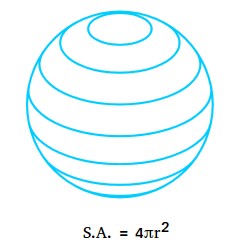
Surface area of a sphere formula
Given the radius, the total curved surface area of a sphere can be found by using the following formula:
S.A. = 4πr2
pi or π is a special mathematical constant, and it is approximately equal to 22/7 or 3.14.
If r or the radius of the sphere is known, the surface area is four times the product of pi and the square of the radius of the sphere.
If you must use the diameter of the sphere, S.A. = 4π(d/2)2 = 4π(d2/4) = πd2
The surface area is expressed in square units.
- If r is measured in feet, then the surface area is measured in square feet or ft2.
- If r is measured in centimeters, then the surface area is measured in square centimeters or cm2.
- If r is measured in inches, then the surface area is measured in square inches or in.2
How to derive the formula of the surface area of the sphere
To derive the formula of the surface area of a sphere, we imagine a sphere with many pyramids inside of it until the base of all the pyramids cover the entire surface area of the sphere. In the figure below, only one of such pyramid is shown.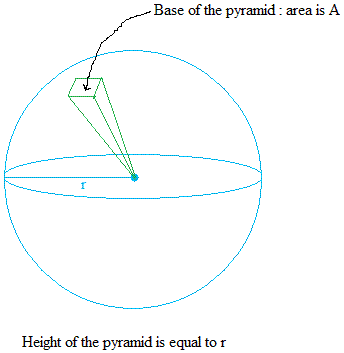
Then, do a ratio of the area of the pyramid to the volume of the pyramid.
The area of the pyramid is Apyramid.
The volume of the pyramid is Vpyramid = (1/3) × Apyramid × r = (Apyramid × r) / 3
So, the ratio of the area of the pyramid to the volume of the pyramid is the following:
Apyramid / Vpyramid = Apyramid ÷ (Apyramid × r) / 3
Apyramid / Vpyramid = (3 × Apyramid) / (Apyramid × r )
Apyramid / Vpyramid= 3 / r
Now pay careful attention to the following important stuff!
Observation # 1:
For a large number of pyramids, let's say that n is such a large number, the ratio of the surface area of the sphere to the volume of the sphere is the same as 3 / r.
Why is that? That cannot be true! Well, here is the reason:
For n pyramids, the total surface area is n × Apyramid
Also for n pyramids, the total volume of the sphere is n × Vpyramid
Therefore, ratio of total surface area of the sphere to total volume of the sphere is
(n × Apyramid) / (n × Vpyramid) = Apyramid / Vpyramid
We have already shown above that Apyramid / Vpyramid = 3 / r
Therefore, S.A.sphere / Vsphere is also equal to 3 / r.
Observation # 2:
Furthermore, n × Apyramid = S.A.sphere (The total area of the bases of all pyramids or n pyramids is approximately equal to the surface area of the sphere)
n × Vpyramid = Vsphere ( The total volume of all pyramids or n pyramids is approximately equal to the volume of the sphere.
Using observation #2, do a ratio of S.A.sphere to Vsphere
S.A.sphere / Vsphere = n(Apyramid) / n(Vpyramid)
Cancel n
S.A.sphere / Vsphere = (Apyramid) / (Vpyramid)
S.A.sphere / Vsphere = 3 / r
Therefore, observation #1 and observation #2 help us to make the following important observation:
S.A.sphere / Vsphere = 3 / r
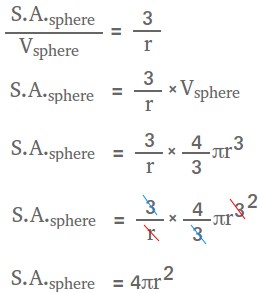
Therefore, the total surface area of a sphere, call it SA is:
SA = 4 × pi × r2
A couple of examples showing how to find the surface area of a sphere.
Example #1:
Find the surface area of a sphere with a radius of 6 cm
SA = 4 × pi × r2
SA = 4 × 3.14 × 62
SA = 12.56 × 36
SA = 452.16
Surface area = 452.16 cm2
Example #2:
Find the surface area of a sphere with a radius of 2 cm
SA = 4 × pi × r2
SA = 4 × 3.14 × 22
SA = 12.56 × 4
SA = 50.24
Surface area = 50.24 cm2
How to find the surface area of a hemisphere
The surface area of a hemisphere is the total area of the surface of the hemisphere. The surface of a hemisphere consists of a circular base and the curved surface of the hemisphere.
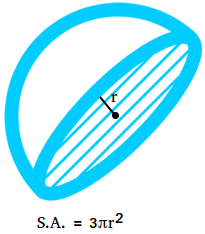
For a hemisphere, the area of the curved surface is half the surface area of the sphere.
Area of the curved surface = (1/2)4πr2
Area of the curved surface = (1/2)4πr2
Area of the curved surface = 2πr2
The area of the circular base is πr2
Surface area of hemisphere = 2πr2 + πr2
Surface area of hemisphere = 3πr2
Example #3:
The diameter of a sphere is 8 cm. Find the surface area of the hemisphere.
r = d/2 = 8/2 = 4
Surface area of hemisphere = 3πr2 = 3π(4)2 = (3)(3.14)(16) = 150.72 cm2
How to find the surface area of a sphere when the volume of a sphere is given in two easy steps
Example #4
The volume of a sphere is 33.5103 cubic units. Find the surface area of the sphere.
Step 1
Use the volume to find the radius of the sphere.
V = (4/3)πr3
33.5103 = (4/3)πr3
33.5103 = (1.3333)(3.14)r3
33.5103 = (4.186562)r3
Divide both sides by 4.186562
33.5103 / 4.186562 = r3
8.004 = r3
r = cube root of 8.004 = 2
Step 2
Use the radius to find the surface area.
S.A. = 4πr2
S.A. = 4(3.14)(2)2
S.A. = (12.56)(4)
S.A. = 50.24 square units