Constructing an isosceles triangle
Recommended Lessons
Not sure where to start? These are the lessons and games we recommend most to students, parents and teachers on Basic-mathematics.com. Each lesson explains the topic in plain language, walks you through worked examples step by step, and ends with practice so you can check your understanding. Pick one below, or use the menu to find lessons on fractions, algebra, geometry, statistics and more.
Step #1:
Take your ruler and a pencil and construct a segment of any length on a piece of paper as shown below.
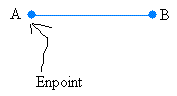
Then, you will open or close your compass opening to a distance bigger or smaller than segment AB.
Take your compass. Make your sure that the pencil is included in it. You may have to put one hand where the needle is and one hand where the pencil is in order to open or close the compass.
Then open or close the compass making sure that the distance of the opening is bigger or smaller than the length of segment AB.
For this situation, we will open the compass to a distance greater than segment AB.
Notice that the reason that we open the compass to a distance bigger or smaller than the length of segment AB is because we do not want the length of segment AB to equal the lengths of the two equal sides.
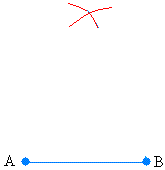
Put the needle of your compass at A and draw an arc.
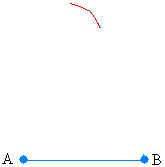
Put the needle of your compass at B and draw an arc.
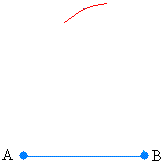
The two arcs should meet as shown below:
Step #3:
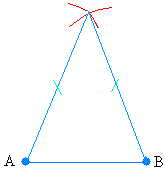
Draw the segments from the two endpoints to the point where the two arcs intersect.
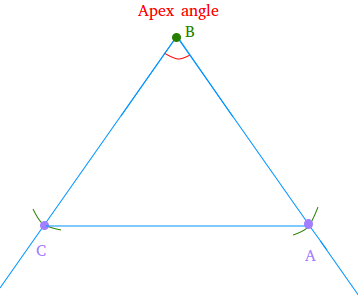
Constructing an isosceles triangle when the apex angle and the lengths of the two equal sides are given.
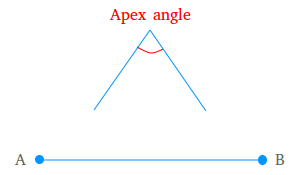
This construction is also straightforward and easy to do. The length of segment AB that you see above will be used for the two equal sides. In an isosceles triangle, the base angles are equal. The apex angle is the angle that is not equal to the base angles.
Here are the steps to follow to construct this isosceles triangle using the length of segment AB and the apex angle.
Step #1:
Using a straightedge, extend the sides of the apex angle so we can easily copy the length of segment AB.
Step #2:
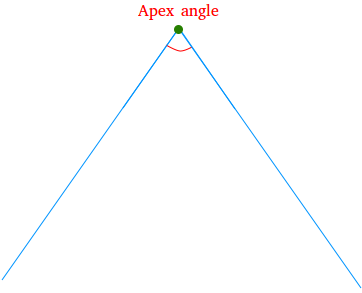
Using your compass, measure the length of segment AB. Then, keeping the opening of the compass the same, put the needle of the compass at the green dot or point B and draw arcs that intersect both sides of the angle. Call these points of intersection A and C.
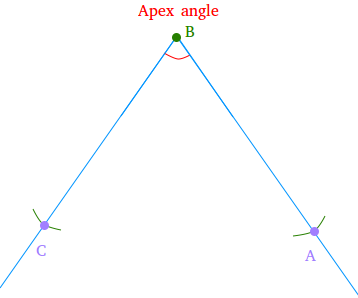
Step #3:
Using your straightedge, draw a segment between A and C. Triangle ABC is an isosceles triangle!