Basic number theory
Get a strong understanding of the very basic of number theory. Life is full of patterns, but oftentimes, we do not realize as much as we should that mathematics too is full of patterns.
Number theory is a branch of pure mathematics that explore the patterns and properties we see when dealing with positive integers.
If I show you the following list: 2, 4, 6, 8, 10,...
You may immediately conclude that the next number after 10 is 12.
If I show you also the following list:
2 × 1, 2 × 2, 2 × 3, 2 × 4,...
What comes next? Of course it is 2 × 5!
In this unit, you will explore some other interesting patterns while I teach the following topics:
- Identify prime and composite numbers
- Find least common multiple
- Find greatest common factor
- Find multiples for a given number
- Divisibility tests
- Counting factors
- To use sets of numbers to find and describe number patterns
- And more
A few problems than can be solved with number theory
Example #1:What is the least number of marbles that can satisfy the following situation:
Put the marbles in 2 piles with no leftovers
Put the marbles in 5 piles with no leftovers
Put the marbles in 7 piles with no leftovers
To solve this problem, you can play around with the marbles until you find the correct combination
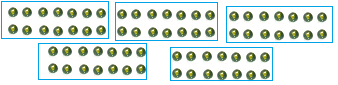 |
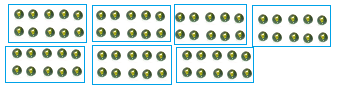 |
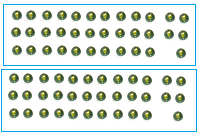 |
However, you could get the least common multiple of 2, 5, and 7.
LCM (2,5,7) = 70
You need 70 marbles
Example #2:
Your father wants to give you some money if the following two conditions are met
- You can share the money with either 2, 3, or 6 people
- The money is less than 100 dollars
You need divisibility rules to solve this problem. There may be more than one solution.
All you have to do is to make sure that the number is divisible by 2, 3, and 6 at the same time.
Possible solutions: 42, 12, and 84
Example #3:
A clown waves at people every 3 minutes
A second clown waves every 4 minutes
A third clown waves every 5 minutes
When will all 3 clowns wave at the same time?
Just get the least common multiple of 3, 4, and 5
LCM(3,4,5) = 60
All clowns will wave at the same time in 60 minutes
Now test yourself to see if you understood the lesson on this page with the number theory quiz below

100 Tough Algebra Word Problems.
If you can solve these problems with no help, you must be a genius!
Recommended