Order of operations
The order of operations is a specific order or a set of rules, agreed upon by mathematicians, one must follow when performing arithmetic operations to simplify expressions.
Order of operations rules
Here is the order for doing operations that you need to follow in the order given below to avoid having different answers when simplifying expressions. If grouping symbols are used such as parentheses, braces, or curly brackets, perform the operations inside the grouping symbols first. Then, proceed with exponents, and so forth...
1. Simplify any expression within parentheses, brackets or grouping symbols: ( ) [ ] { }
2. Simplify powers or expressions involving exponents: 42, 25, or 53
3. Multiply and divide in order from left to right: × and ÷
4. Add and subtract in order from left to right: + and -
Order of operations problems
Study the example in the figure below carefully so that you understand how to use the order of operations!
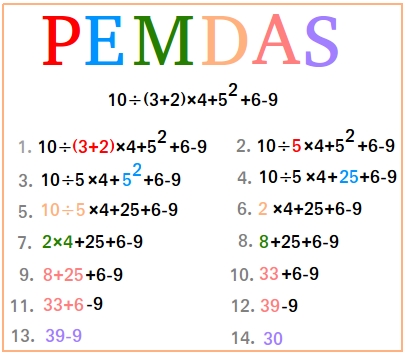
More examples showing how to use the order of operations
Example #1:
42 - 6 × 2 ÷ 4 × 3 + 5
Do exponent:
16 - 6 × 2 ÷ 4 × 3 + 5
Multiply and divide from left to right
16 - 12 ÷ 4 × 3 + 5
16 - 3 × 3 + 5
16 - 9 + 5
Add and subtract from left to right
16 - 9 + 5
7 + 5
12
Example #2:
(2 + 52) + 4 × 3 - 10
Do parenthesis:
(2 + 25) + 4 × 3 - 10
27 + 4 × 3 - 10
Do multiplication
27 + 12 - 10
Add
39 - 10
Subtract
29
Example #3:
10 - 14 ÷ 2 = 10 - 7 = 3 (Division comes before subtraction)
Remember that if you see multiplication and division at the same time, perform the operation from left to right.
Example #4:
4 + 5 ÷ 5 × 6 = 4 + 1 × 6 = 4 + 6 =10
How to remember the order of operations
The following acronyms can make it easier for you to remember the order of operations.
- PEMDAS (used mostly in the United States of America and also in France)
- BODMAS (used mostly in UK, Australia, and India)
- BEDMAS (used in Canada and New Zealand)
- BIDMAS
The following mnemonic may help you remember the PEMDAS rule:
PEMDAS (Please Excuse My Dear Aunt Sally)
- The P stands for parentheses
- The E stands for exponents
- The M stands for multiply
- The D stands for division
- The A stands for add
- The S stands for subtraction
Even though M comes before D in PEMDAS, the two operations have the same precedence. Same precedence means that multiplication is not more important than division. By the same token, even though A comes before S, the two operations have the same precedence. Addition is not more important than subtraction.
A much better way, in my opinion, to write PEMDAS is P-E-MD-AS.
In P-E-MD-AS, operations with the same precedence have no hyphens between them.
For example, since addition and subtraction have the same precedence, there is no need to put a hyphen between them.
However, P and E have a hyphen between them because P has a higher precedence than E.
All the four letters in MDAS, DMAS, DMAS, and DMAS refer to multiplication, division, addition, and subtraction.
- In BODMAS rule, the B stands for bracket and the O stands for order. Order can be powers or roots.
- In BEDMAS rule, the B stands for bracket and the E stands for exponents.
- In BIDMAS rule, the B stands for bracket and the I stands for indices. Indices are powers such as 62
Keep in mind also that PEMDAS, BODMAS, BEDMAS, and BIDMAS are all correct ways to perform the order operations. None of them is better than the other. These are just names that are used, based on the country, to make it easier to remember the rules.
What about nested parentheses in the order of operations?
Example #5:
Simplify √4 + 1 + {2 - [(6 - 2) × 5] + 13}.
Work first with the innermost set of parentheses or (6 - 2).
√4 + 1 + {2 + [(6 - 2) × 5] + 13} = √4 + 1 + {2 - [4 × 5] + 13}
Next, work again first with the inner set of parentheses or [4 × 5].
√4 + 1 + {2 + [(6 - 2) × 5] + 13} = √4 + 1 + {2 - 20 + 13}
Stay inside the parentheses until you are done. While working inside the parentheses, notice that you need to add and subtract in order from left to right.
√4 + 1 + {2 + [(6 - 2) × 5] + 13} = √4 + 1 + {-18 + 13}
√4 + 1 + {2 + [(6 - 2) × 5] + 13} = √4 + 1 + -5
According to BODMAS rule, you need to do root first.
√4 + 1 + {2 + [(6 - 2) × 5] + 13} = 2 + 1 + -5
Add and subtract again in order from left to right
√4 + 1 + {2 + [(6 - 2) × 5] + 13} = 3 + -5
√4 + 1 + {2 + [(6 - 2) × 5] + 13} = -2
The final answer is -2
A real-life example of PEMDAS
The order of operations is a very important skill to have since you use it every day even if you are not aware of this.Say for instance,you go to the supermarket. Suppose peanuts cost $3.00 per pound and a bottle of water is 1 dollar. You get yourself 2 pounds of peanuts and 1 bottle of water.
How much money do you pay?
Since 1 pound of peanuts is 3 dollars and you bought 2 pounds, peanuts cost 6 dollars. Add that to the amount you pay for the water(1 dollar), you paid a total of 7 dollars.
You may have figured this out without any major problems. However, if I present you with the following equation, which is a model of the problem above, you might have a tendency to add 3 to 1 and multiply the result by 2. That will be the incorrect way to do it!
2 × 3 + 1
Doing this will give 8 and it is not equal to 7.
The correct way is to do multiplication first and then add the product to 1.
Order of operations quiz. See how you understand this lesson.

100 Tough Algebra Word Problems.
If you can solve these problems with no help, you must be a genius!

Recommended