Complement of a set
This lesson will explain how to find the complement of a set. We will start with a definition.Given a set A, the complement of A is the set of all element in the universal set U, but not in A. We can write Ac. You can also say complement of A in U.
Example #1.
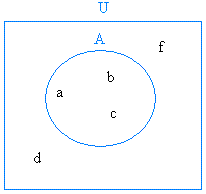
Therefore Ac = {d, f}
Sometimes, instead of looking at a the Venn Diagrams, it may be easier to write down the elements of both sets
Then, we show in bold the elements that are in U, but not in A
A = { a, b, c}
U = { a, b, c, d, f}
Example #2.
Let B = {1 orange, 1 pineapple, 1 banana, 1 apple}
Let U = {1 orange, 1 apricot, 1 pineapple, 1 banana, 1 mango, 1 apple, 1 kiwifruit }
Again, we show in bold all elements in U, but not in B
Bc = {1 apricot, 1 mango, 1 kiwifruit}
Example #3.
Find the complement of B in U
B = { 1, 2, 4, 6}
U = {1, 2, 4, 6, 7, 8, 9 }
Complement of B in U = { 7, 8, 9}
Example #4.
Find the complement of A in U
A = { x / x is a number bigger than 4 and smaller than 8}
U = { x / x is a positive number smaller than 7}
A = { 5, 6, 7} and U = { 1, 2, 3, 4, 5, 6}
Ac = { 1, 2, 3, 4}
Or Ac = { x / x is a number bigger than 1 and smaller than 5 }
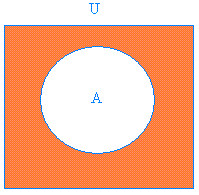
The graph below shows the shaded region for the complement of set A
Complement of a set quiz. Take the quiz to see how well you understand this lesson.

100 Tough Algebra Word Problems.
If you can solve these problems with no help, you must be a genius!

Recommended