Pythagorean theorem
The Pythagorean Theorem was named after famous Greek mathematician Pythagoras. It is an important formula that states the following: a2 + b2 = c2
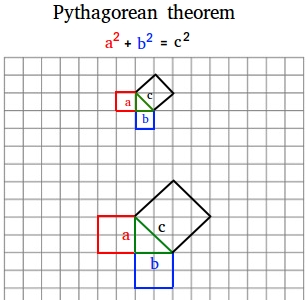
Looking at the figure above, did you make the following important observation? This may help us to see why the formula works.
- The red square has 2 triangles in it
- The blue square has also 2 triangles in it
- The black square has 4 of the same triangle in it
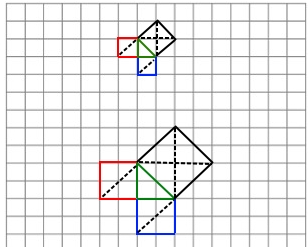
Therefore, area of red square + area of blue square = area of black square
Let a = the length of a side of the red square
Let b = the length of a side of the blue square
Let c = the length of a side of the black square
Therefore, a2 + b2 = c2
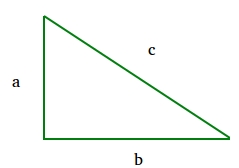
Thus, given two sides, the third side can be found using the formula.
We will illustrate with examples, but before proceeding, you should know how to find the square root of a number and how to solve equations using subtraction.
Examples showing how to use the Pythagorean theorem
Exercise #1
Let a = 3 and b = 4. Find c, or the longest side
c2 = a2 + b2
c2 = 32 + 42
c2= 9 + 16
c2 = 25
c = √25
The sign (√) means square root
c = 5
Exercise #2
Let c = 10 and a = 8. Find b, or the other leg.
c2 = a2 + b2
102 = 82 + b2
100 = 64 + b2
100 - 64 = 64 - 64 + b2 (minus 64 from both sides to isolate b2 )
36 = 0 + b2
36 = b2
b = √36 = 6
Exercise #3
Let c = 13 and b = 5. Find a
c2 = a 2+ b2
132 = a2 + 52
169 = a2 + 25
169 - 25 = a2 + 25-25
144 = a2 + 0
144 = a2
a = √144 = 12
Take the Pythagorean theorem quiz below to see how well you understand this lesson.
|
Buy a comprehensive geometric formulas ebook. All geometric formulas are explained with well selected word problems so you can master geometry.  |

100 Tough Algebra Word Problems.
If you can solve these problems with no help, you must be a genius!
Recommended