Linear Equations
Linear equations are all equations that have the following form: y = ax + b, a and b are real numbers and are called constants.
In y = ax + b, x is called independent variable and y is called dependent variable.
Some examples of linear equations are y = 2x + 5 with a = 2 and b = 5, y = -3x + 2 with a = -3 and b = 2, and y = 4x + - 1 with a = 4 and b = -1
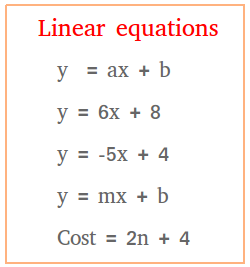
Linear and non-linear equations
Notice that all linear equations are equations of degree 1, meaning that the variable cannot be raised to a power other than 1. If the power of the equation is not 1, you are dealing with non-linear equations.
For example, y = 3x, y = x2 - 3x + 2, y = √x, and y = (x - 3) / x + 2 are non-linear equations.
It may not be obvious why y = (x - 3) / x + 2 is not a linear equation. Let us rewrite the equation by multiplying each side of the equation by x + 2.
y(x + 2) = (x - 3)
xy + 2y = x - 3
xy + 2y - x + 3 = 0
The term that is raised to a power other than 1 is xy. This term can also give us the degree of this equation. Just add the exponents for each variable to get the degree. Therefore the degree is 2 since xy = x1y1
y = √x is not a linear equation either since it can be written as y = x1/2 and x1/2 is not an equation of degree 1.
Forms of linear equations
A linear equation can have different forms. There are three major forms. Then, the other forms, that are less common, are to write linear equations as functions and the intercept form.
Here are the three major forms of linear equations
- Slope-intercept form
- Point-slope form
- General form or standard form of a linear equation
Slope-intercept form of a linear equation
y = mx + b, where m is the slope, b is the y-intercept, x is the coordinate of the x-axis, and y is the coordinate of the y-axis.
The name "slope-intercept form" came from the fact that you can clearly and quickly identify the slope and the y-intercept in the equation. This can help to quickly graph the line of the equation.
For example, y = 5x - 6 is in slope-intercept form where 5 is the slope and -6 is the y-intercept.
Point-slope form of a linear equation
y - y1 = m(x - x1), where m is the slope and (x1, y1) is a point on the line.
The name "point-slope form" also came from the fact that you can clearly and quickly identify the slope and a point just by looking at the equation. This can help you quickly graph the line of the equation. You do this by putting the point first on the coordinate plane. Then, use the slope to find one more point. Finally draw a straight line between the two points. See how this is done in the lesson about graphing slope.
For example, y = 5x - 6 can be written in point-slope form as y + 1 = 5(x - 1) or y - -1 = 5(x - 1)
5 is the slope and (-1, 1) is a point on the line.
General form of a linear equation
Ax + By = C, where A, B, and C are real numbers and A and B are not both zero.
The name "general form" most likely came from the fact that you cannot quickly identify anything specific in the equation such as the slope. However, the general form can be used to quickly find the x-intercept and the y-intercept.
For example, the general of y = 5x - 6 is 5x - y = 6
The standard form of linear equations with two variables can be written as Ax + By = C where A, B, and C are real numbers and A and B are not both zero.
When either the variable x or the variable y is equal to zero, we get Ax = C or By = C.
An equation of the form Ax = C or By = C is called linear equation with one variable. A and B cannot be zeros.
Less common forms of linear equations
As a function
The equation y = 5x - 6 can also be written as a function with f(x), g(x), h(x) ... instead of y.
f(x) = 5x - 6
g(x) = 5x - 6
h(x) = 5x - 6
The intercept form
x/a + y/b = 1, where a is the x-intercept and b is the y-intercept
For example, y = 5x - 6 can be written in intercept form as (x / 1.2) + (y / -6) = 1
An interesting math problem leading to a linear equation
I am thinking of a number. If I add 2 to that number, I will get 5. What is the number?
Although it may be fairly easy to guess that the number is 3, you can model the situation above with a linear equation.
Let x be the number in my mind.
Add 2 to x to get 5.
Adding 2 to x to get 5 means that whatever x is, when I add 2 to x, it has to equal to 5.
The equation is 2 + x = 5
A real-life example leading to a linear equation
Soon or later, we need the service of a taxi driver. Taxi drivers usually charge an initial fixed fee as part of using their services. Then, for each mileage, they charge a certain amount.
Say for instance the initial fee is 4 dollars and each mileage cost 2 dollars.
The total cost can be modeled with an equation that is linear.
Let y be the total cost.
Let n be number of mileage.
Total cost = 4 + cost for n miles.
Notice that cost for n miles = N × 2.
Therefore, y = 4 + n × 2.
Say for instance, a taxi driver takes you to a distance of 20 miles, how much money do you have to pay using y = 4 + n × 2 ?
When n = 20, y = 4 + 20 × 2 = 4 + 40 = 44 dollars
Now, let's ask the question the other way around!
If you pay 60 dollars, how far did the taxi driver took you?
This time = 60
Replacing 60 into the equation gives you the following equation:
60 = 4 + n × 2
It is not obvious to see that n = 28.
That is why it is important to learn to solve linear equations!
Real life examples or word problems on linear equations are numerous.