Graphing Slope
Recommended for You
Not sure where to start? These are the lessons and games we recommend most to students, parents and teachers on Basic-mathematics.com. Each lesson explains the topic in plain language, walks you through worked examples step by step, and ends with practice so you can check your understanding. Pick one below, or use the menu to find lessons on fractions, algebra, geometry, statistics and more.
Enhanced Slope Visualization with Practice Mode
Interactive slope visualization with dynamic scaling and navigation:
- Use zoom controls, mouse wheel, or pinch gestures to zoom in/out
- Click and drag or use touch gestures to pan around the coordinate plane
- The grid automatically adjusts based on your input values
Tip: Enter slope as a fraction (3/2) or decimal (1.5)
Graphing slope is the goal of this lesson. We will show you here how easy the process is using the slope and any point given.
A couple of examples showing how graphing slope works
Example #1:
Given a point of (1, 2) and a slope of 5/2, graph the slope of the line.
First, we need to locate the point (1, 2) and put it on the coordinate system.
We show the point (1, 2) with a blue dot in the figure below.
Then, from that point, you will need to show a slope of 5/2
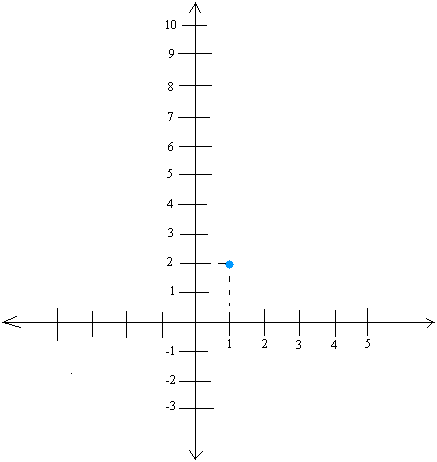
Using the slope of 5/2, we see that 5 is the rise and 2 is the run or horizontal distance.
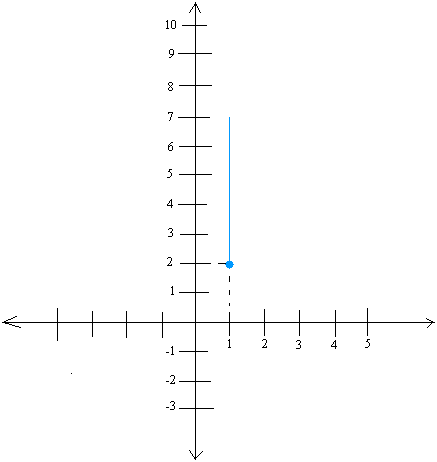
Now, starting at the point (1,2) or the blue dot, draw a rise of 5. In other words, count 5 units straight up as you draw a line. You will end up at the point (1,7) after you are done.
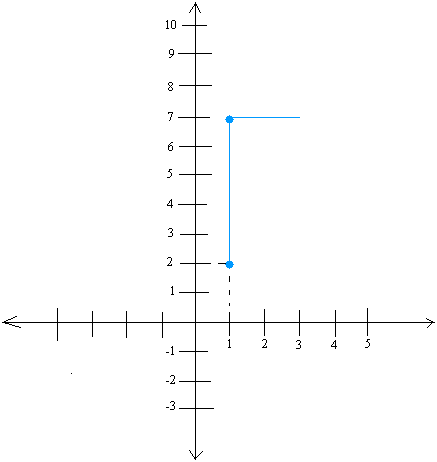
Now, starting at point (1,7), draw a run of 2 or count 2 units horizontally as you draw a line. You will end up at the point (3,7) once you are done doing this.
Recall that when drawing the run, you will always move from left to right.
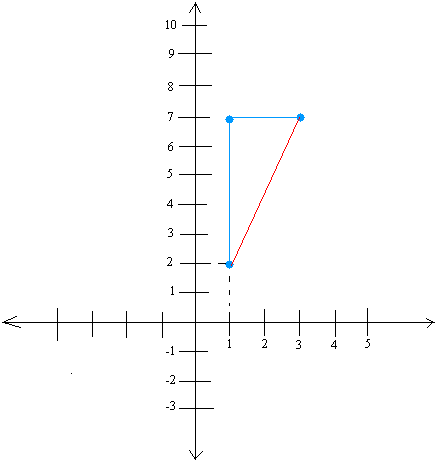
Finally, draw a line between your starting point and your final point. This is the slope of the line, which we show below with a red line.
Example #2:
Given a point of (2, 7) and a slope of -3/2, graph the slope of the line.
First, locate the point (2, 7) and put it on the coordinate system.
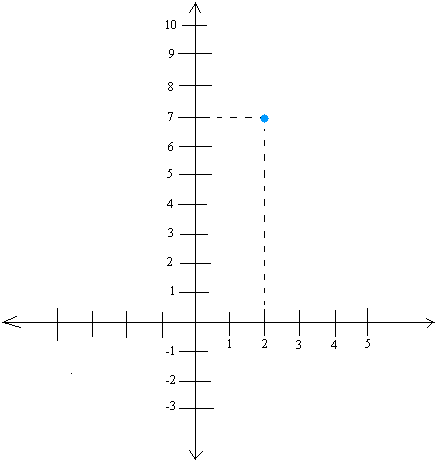
Using the slope of -3/2, we see that 3 is the fall and 2 is the run or horizontal distance.
Notice that this time we don't rise, but fall because the slope is negative.
Now, starting at the point (2,7) draw a fall of 3. In other words, count 3 units straight down as you draw a line. Once you are done, you will end point at the point (2, 4).
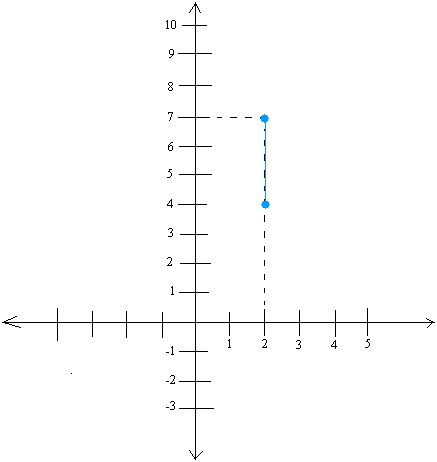
Starting at point (2,4), draw a run of 2 or count 2 units horizontally as you draw a line. Once you are done, you will end up at the point (4,4)
Again, when drawing the run, you will always move from left to right.
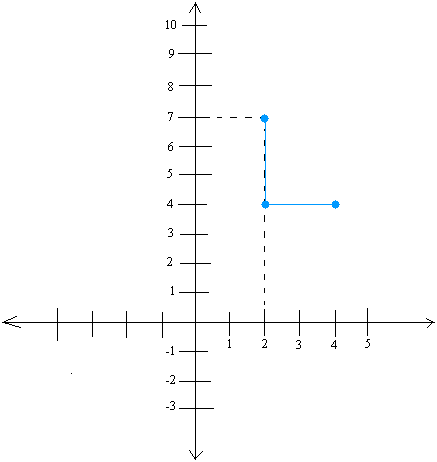
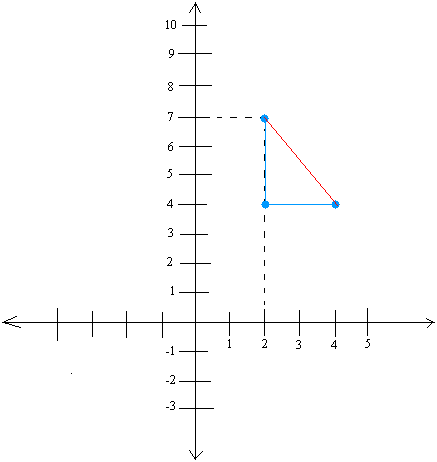
Finally, draw a line between your starting point and your final point. This is the slope of the line.
Share this page