Proof of the Angle Sum Theorem
Recommended for You
Not sure where to start? These are the lessons and games we recommend most to students, parents and teachers on Basic-mathematics.com. Each lesson explains the topic in plain language, walks you through worked examples step by step, and ends with practice so you can check your understanding. Pick one below, or use the menu to find lessons on fractions, algebra, geometry, statistics and more.
The three angles of any triangle add up to 180°.
For triangle ABC: ∠A + ∠B + ∠C = 180°. This is called the angle sum theorem, or the triangle sum theorem.
It doesn't matter whether the triangle is small or large, acute, right or obtuse. The total is always 180°.
This makes it easy to find a missing angle. If two angles of a triangle measure 50° and 60°, the third angle is 180° − 50° − 60° = 70°.
On this page you will first see why the theorem works with a numerical example, and then prove it for every triangle.
Three facts the proof uses
- Parallel line through a point. Through a point that is not on a line, you can draw exactly one line parallel to that line.
- Alternate interior angles. When a line (called a transversal) crosses two parallel lines, the alternate interior angles are equal. We accept this fact without proof.
- Straight angle. Angles that together form a straight line add up to 180°.
Watch out: alternate interior angles are equal only when the two lines are parallel. If the lines are not parallel, the angles can be different.
Alternate interior angles
In the figure below, two parallel lines are cut by a transversal. Alternate interior angles lie between the parallel lines, on opposite sides of the transversal.
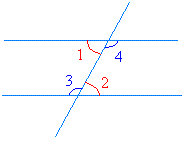
The figure shows two pairs of alternate interior angles. For the red pair, ∠1 = ∠2. For the blue pair, ∠3 = ∠4.
Seeing it with numbers
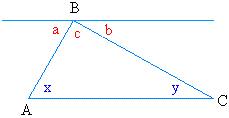
Look at triangle ABC below. Angle A measures 65° and angle C measures 30°. We claim that angle x must be 85°, so that the three angles add up to 180°.

To see why, draw a line through vertex B that is parallel to side AC.

- Side AB is a transversal of the two parallel lines, so angle a and the 65° angle at A are alternate interior angles. That makes angle a = 65°.
- Side BC is also a transversal, so angle b and the 30° angle at C are alternate interior angles. That makes angle b = 30°.
- Angles a, x and b sit side by side and form a straight line, so 65° + x + 30° = 180°.
- Solving: x = 180° − 95° = 85°.
This example shows that the theorem works for one triangle. It is not yet a proof, because a proof must work for every triangle.
The proof
Start with any triangle ABC, with angles x at A, c at B and y at C. Draw a line through B parallel to AC. This creates angles a and b on either side of angle c.
| # | Statement | Reason |
|---|---|---|
| 1 | The line through B is parallel to AC. | Through a point not on a line, there is exactly one parallel line. |
| 2 | a + c + b = 180° | Angles a, c and b form a straight line. |
| 3 | a = x | Alternate interior angles (transversal AB) are equal. |
| 4 | b = y | Alternate interior angles (transversal BC) are equal. |
| 5 | x + c + y = 180° | Substitute x for a and y for b in step 2. |
Since x, c and y are the three angles of triangle ABC, the angles of the triangle add up to 180°. Nothing in the proof depended on the size or shape of the triangle, so it works for every triangle. ∎
What follows from the theorem
- Each angle of an equilateral triangle measures 180° ÷ 3 = 60°.
- In a right triangle, the two acute angles add up to 180° − 90° = 90°.
- A triangle can have at most one right angle or obtuse angle, because two of them would already add up to 180° or more.
Tip: to find a missing angle, add the angles you know and subtract the total from 180°.
Practice problems
Pick an answer for each question. You'll see right away whether it's correct, with an explanation.
1. Two angles of a triangle measure 40° and 75°. What is the third angle?
180° − 40° − 75° = 65°. (115° is the sum of the two known angles, not the missing one.)
2. One acute angle of a right triangle measures 28°. What is the other acute angle?
The right angle is 90°, so the other angle is 180° − 90° − 28° = 62°. The two acute angles of a right triangle always add up to 90°.
3. The angle between the two equal sides of an isosceles triangle is 40°. What is each of the other two angles?
The two base angles are equal. Together they measure 180° − 40° = 140°, so each one is 140° ÷ 2 = 70°.
4. The angles of a triangle measure x, 2x and 3x. What is x?
x + 2x + 3x = 180°, so 6x = 180° and x = 30°. The angles are 30°, 60° and 90°.
5. In the proof, why is angle a equal to angle x?
The line through B is parallel to AC, and side AB crosses both of them. Angles a and x are on opposite sides of AB, between the parallel lines, so they are equal alternate interior angles.
Share this page