Virtual Base-Ten Blocks
On this page, you will learn
- How ones, tens and hundreds blocks show place value.
- How to build and read any number from 1 to 999 with blocks.
- How to regroup: trade 10 ones for 1 ten, or break 1 ten into 10 ones.
- How to add and subtract with regrouping, step by step.
Interactive Base-Ten Blocks
Pick a mode. Build any number, make a target number, or add and subtract with regrouping. Tap a block to add it, or drag it onto the mat.
Build the number 0
How to Use the Interactive Blocks
- Build: tap a block (or drag it onto the mat) to add it, and tap a block on the mat to remove it. The number shows under the mat. Use the trade buttons to swap 10 ones for 1 ten, or to break a block into 10 smaller ones.
- Make a Number: build the number shown, then press Check. Any correct set of blocks counts, and the tool tells you when a trade would show it with fewer blocks.
- Add: type two numbers (or press New problem). Push the blocks together, then work from the ones to the hundreds. Each time a place has 10 or more blocks, trade 10 of them for 1 bigger block. The column addition beside the mat fills in as you go.
- Subtract: type two numbers. Take away blocks from the ones to the hundreds. When there are not enough blocks to take away, break 1 bigger block into 10 smaller ones.
Teachers: the blocks work on an interactive whiteboard or a projector. Use Make a Number for a quick warm-up, and Add or Subtract to show why we carry and borrow.
What Are Base-Ten Blocks?
Base-ten blocks are math blocks that show place value. Each kind of block stands for one place in our number system.
- One (cube)A small cube. It is worth 1.
- Ten (rod)A row of 10 cubes. It is worth 10.
- Hundred (flat)A square of 10 rods, or 100 cubes. It is worth 100.
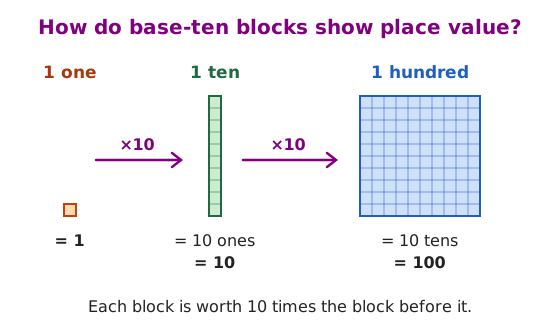
10 of one kind of block make 1 of the next bigger block: 10 ones = 1 ten, and 10 tens = 1 hundred.
- The hundreds digit is 2, so take 2 flats. They are worth 200.
- The tens digit is 4, so take 4 rods. They are worth 40.
- The ones digit is 3, so take 3 cubes. They are worth 3.
- Check: 200 + 40 + 3 = 243.
243 = 2 flats + 4 rods + 3 cubes
Skipping an empty place. 4 flats and 6 cubes show 406, not 46. When there are no rods, write 0 in the tens place.
What number do 3 flats, 5 rods and 0 cubes show?
Show answer
350. 3 flats are 300 and 5 rods are 50. There are no cubes, so the ones digit is 0.
Regrouping: Trading 10 Blocks for 1
Regrouping means trading blocks without changing the number. You trade up when a place has 10 or more blocks. You trade down, or break a block, when you need more of a smaller block.
- Trade up (adding)10 ones → 1 ten
10 tens → 1 hundred - Trade down (subtracting)1 ten → 10 ones
1 hundred → 10 tens
- 15 ones is 10 or more, so trade 10 ones for 1 ten.
- Now there are 4 tens and 5 ones.
- 4 tens and 5 ones = 40 + 5.
3 tens and 15 ones = 45
You break 1 ten from 6 tens and 2 ones. Which blocks do you have now?
Show answer
5 tens and 12 ones. The number is still 62: 50 + 12 = 62.
Adding and Subtracting with Base-Ten Blocks
To add, put the blocks for both numbers together. Then start with the ones: if there are 10 or more, trade 10 ones for 1 ten. Do the same with the tens. This trade is the carry in column addition.
To subtract, show only the first number and take blocks away, starting with the ones. If there are not enough blocks to take away, break 1 bigger block into 10 smaller ones. This is the borrow in column subtraction.
- Show 52: 5 rods and 2 cubes.
- You need to take away 7 ones, but there are only 2 cubes. Break 1 rod into 10 cubes. Now there are 4 rods and 12 cubes.
- Take away 7 cubes. 5 cubes are left.
- Take away 2 rods. 2 rods are left.
52 − 27 = 25 (2 rods and 5 cubes)
Subtracting the smaller digit from the bigger one. In 52 − 27, doing 7 − 2 = 5 in the ones gives 35, which is wrong. Break a ten instead.
You add 38 + 45 with blocks and get 7 tens and 13 ones. What is the sum?
Show answer
83. Trade 10 ones for 1 ten: 8 tens and 3 ones.
Summary
- A cube is 1, a rod is 10 and a flat is 100.
- Each block is worth 10 times the block before it.
- To read the blocks, write one digit for each place, and write 0 for an empty place.
- Regrouping trades blocks without changing the number: 10 ones = 1 ten, and 10 tens = 1 hundred.
- When adding, trade 10 blocks for 1 bigger block. When subtracting, break 1 bigger block into 10 smaller ones.
Test Yourself: Interactive 10-Question Quiz
Now check what you learned. Every answer is explained, and each time you play you get new questions.
Quiz Complete!