Formula for Percentage
The formula for percentage is the following and it should be easy to use if you follow the directions given in the interactive lesson below. Study the formula below carefully before looking at the examples.
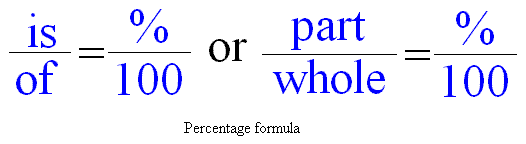

A percent is a number out of 100. The formula for percentage turns any percent problem into a proportion. Decide which two of the three you know (the part, the whole or the percent) and which one is missing. Put them in the formula, then cross multiply and divide to find the missing number. Cross-multiply means to multiply the numerator of one fraction by the denominator of the other fraction.
- The number after of is the whole. It goes on the bottom.
- The number with is is the part. It goes on top.
- The percent goes over 100.
- Then cross multiply and divide to find the missing number.
See the proportion
The part compares to the whole the same way the percent compares to 100. Move the slider and pick a whole to see it.
Worked examples
Your turn
Common mistakes
- Putting the whole on top. The whole is the number after "of", and it always goes on the bottom: 36/150, not 150/36.
- Following the word order. "36 is 24% of what number?" and "24% of what number is 36?" ask the same thing. Look for the word "of" to find the whole, wherever it is in the sentence.
- Forgetting the 100. The percent always sits over 100. 25% means 25/100, not 25.
- Dividing by the wrong number. After you cross multiply, divide by the number that is multiplied by the unknown, not always by 100.
- Leaving off the percent sign. When the question asks "what percent", the answer is a percent: 20%, not 20 or 0.2.
- Not checking. A part smaller than the whole means a percent under 100%. If your answer breaks that, look again.
Find below some of the examples from the interactive lesson, written out in full if you would rather read them without help.
How to Use the Formula for Percentage on the Left
Example #1:
25% of 200 is ____
In this problem, of = 200, is = ?, and % = 25
We get:
Since is is an unknown, you can replace it by y to make the problem more familiar.
Cross multiply to get y × 100 = 200 × 25
y × 100 = 5000
Divide 5000 by 100 to get y
Since , y = 50
So, 25% of 200 is 50
Example #2:
What number is 2% of 50?
This is just another way of saying 2% of 50 is ____
So, set up the proportion as in example #1:
Replace is by y and cross multiply to get:
y × 100 = 50 × 2
y × 100 = 100
Since 1 × 100 = 100, y = 1
Therefore, 1 is 2% of 50
Example #3:
24% of ____ is 36
This time, notice that is = 36, but of is missing
After you set up the formula, you get:
Replace of by y to get:
Cross multiply to get:
y × 24 = 36 × 100
y × 24 = 3600
Divide 3600 by 24 to get y
, so y = 150
Therefore, 24% of 150 is 36
How to Use the Other Formula for Percentage on the Right
Now, we will take examples to illustrate how to use the formula for percentage on the right
Example #4:
To use the other formula that says part and whole, just remember the following:
- The number after of is always the whole.
- The number after is is always the part.
If a problem says 25% of ____ is 60, then we know that the whole is missing and the part = 60
Your proportion will look like this:
After cross multiplying, we get:
whole × 25 = 60 × 100
whole × 25 = 6000
Divide 6000 by 25 to get whole
, so whole = 240
Therefore, 25% of 240 is 60
Example #5:
____% of 45 is 9
Here whole = 45 and part = 9, but % is missing
We get:
Replacing % by x and cross multiplying gives:
9 × 100 = 45 × x
900 = 45 × x
Divide 900 by 45 to get x
, so x = 20
Therefore, 20% of 45 is 9
Here we go! I hope the formula for percentage was helpful.