How to Do Synthetic Division
In this lesson, you will learn
- when you can use synthetic division and how to set it up
- the repeating pattern: bring down, multiply, add
- how to read the quotient and the remainder from the bottom row
- how to handle a missing power of x
What Is Synthetic Division?
This lesson will explain how to do synthetic division to quickly divide a polynomial by a divisor of the form x − c.
Synthetic division is a short way to divide a polynomial by x − c (or x + c). It does the same job as polynomial long division, but you only write the numbers: no x's and no subtracting.
Synthetic division is also called the method of detached coefficients. This is because the first step in synthetic division is to remove the coefficients from the polynomial that is being divided.
The divisor must be x plus or minus a number, such as x − 2 or x + 5. For a divisor such as x2 + 1, use polynomial long division instead.
The three rows of a synthetic division
Every synthetic division has the same layout. Here is a finished one, x3 + 5x2 − 2x − 24 divided by x − 2, which you will build step by step in Example 2:
| 2 | 1 | 5 | −2 | −24 | coefficients of the dividend |
| 2 | 14 | 24 | products: bottom number × number on the left | ||
| 1 | 7 | 12 | 0 | sums: quotient coefficients, then the remainder |
- The number on the left is the number from the divisor with its sign reversed: x − 2 gives 2. It is the value of x that makes the divisor equal 0.
- The top row holds the coefficients of the polynomial you divide.
- The middle row holds products: each bottom number times the number on the left.
- The bottom row holds the sums of each column. The last sum, in its own box, is the remainder.
Example 1: Divide x2 + 11x + 30 by x + 5
A couple of synthetic division examples are shown below.
Divide x2 + 11x + 30 by x + 5
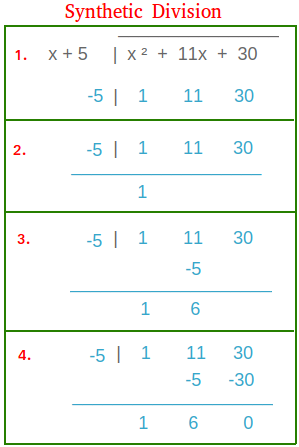
Explanation of the steps we took while using synthetic division to divide x2 + 11x + 30 by x + 5.
- Reverse the sign of the constant term in the divisor. For example, the constant term in the divisor is 5. Change it to −5. Remove the coefficients from the dividend and rewrite the division as shown above in blue.
- Bring down the first coefficient or 1. The 1 will begin the quotient.
- Multiply the first coefficient by the new divisor (−5) and add the answer to the next coefficient or 11. We get 6. Write down 6 in the same column as 11 and −5.
- Keep multiplying and adding until the remainder is found. For example, multiply 6 by −5. We get −30. Add −30 to 30 to get 0 and 0 is the remainder. In fact, the last number on the right that you find after you add is the remainder whether it is 0 or not.
To read the answer, drop the last number of the bottom row (the remainder). The other numbers are the coefficients of the quotient, which starts one power lower than the polynomial you divided.
Here the bottom row is 1, 6 | 0. The dividend starts with x2, so the quotient starts with x:
The quotient is x + 6 and the remainder is 0.
Check: (x + 6)(x + 5) = x2 + 5x + 6x + 30 = x2 + 11x + 30
Divide x2 + 7x + 12 by x + 3.
Show answer
x + 4, remainder 0. The number on the left is −3. Bring down 1; 1 × (−3) = −3 and 7 + (−3) = 4; 4 × (−3) = −12 and 12 + (−12) = 0.
Example 2: Synthetic Division When the Degree of the Polynomial Is 3
Divide x3 + 5x2 − 2x − 24 by x − 2
Step 1: Reverse the sign of the constant term in the divisor.
In other words, change −2 in x − 2 into 2 and write it on the left. Then write the coefficients of x3 + 5x2 − 2x − 24 in the top row: 1, 5, −2, −24.
| 2 | 1 | 5 | −2 | −24 |
Step 2: Bring down the first coefficient or 1.
The 1 will begin the quotient.
| 2 | 1 | 5 | −2 | −24 |
| 1 |
Step 3: Multiply 1 by 2 and add the result to 5.
1 × 2 = 2. Write 2 under 5, then add the column: 5 + 2 = 7. Write 7 in the bottom row.
| 2 | 1 | 5 | −2 | −24 |
| 2 | ||||
| 1 | 7 |
Step 4: Multiply 7 by 2 and add the result to −2. Keep multiplying and adding until the remainder is found.
7 × 2 = 14, and −2 + 14 = 12.
| 2 | 1 | 5 | −2 | −24 |
| 2 | 14 | |||
| 1 | 7 | 12 |
12 × 2 = 24, and −24 + 24 = 0. This last sum is the remainder.
| 2 | 1 | 5 | −2 | −24 |
| 2 | 14 | 24 | ||
| 1 | 7 | 12 | 0 |
The bottom row is 1, 7, 12 | 0. The dividend starts with x3, so the quotient starts with x2:
The quotient is x2 + 7x + 12 and the remainder is 0.
Why reverse the sign? x − 2 equals 0 when x = 2, so 2 goes on the left. And because you use 2 instead of −2, you add each column instead of subtracting, as you would in long division.
Forgetting to reverse the sign. For x − 2 the number on the left is 2, and for x + 5 it is −5. With the wrong sign, every number after the first one comes out wrong.
What number goes on the left when you divide by x + 4? And when you divide by x − 7?
Show answer
−4 and 7. Reverse the sign of the number in the divisor.
Missing Terms and Remainders
Sometimes a power of x is missing, and often the remainder is not 0. Here is how to handle both.
Write 0 in the top row for every missing power of x. Every power, from the highest down to the constant, needs its own column.
- The number on the left is −2, because x + 2 has +2.
- There is no x2 term, so the top row is 2, 0, −3, 5.
- Bring down 2.
- 2 × (−2) = −4, and 0 + (−4) = −4.
- −4 × (−2) = 8, and −3 + 8 = 5.
- 5 × (−2) = −10, and 5 + (−10) = −5. This is the remainder.
| −2 | 2 | 0 | −3 | 5 |
| −4 | 8 | −10 | ||
| 2 | −4 | 5 | −5 |
Quotient 2x2 − 4x + 5, remainder −5: 2x3 − 3x + 5 = (x + 2)(2x2 − 4x + 5) − 5
When the remainder is not 0, write the answer as the quotient plus the remainder over the divisor:
Skipping the 0 for the missing x2. With the top row 2, −3, 5 you get 2, −7 | 19, which is wrong: the numbers slide into the wrong columns.
| −2 | 2 | −3 | 5 |
| −4 | 14 | ||
| 2 | −7 | 19 |
A fast way to check: the remainder of a division by x − c equals the value of the polynomial at x = c. Here c = −2: 2(−2)3 − 3(−2) + 5 = −16 + 6 + 5 = −5. It matches.
What top row do you write to divide x3 − 8 by x − 2?
Show answer
1, 0, 0, −8. The x2 and x terms are missing, so each gets a 0.
Summary
- Synthetic division divides a polynomial by x − c or x + c using only the coefficients.
- Write the number from the divisor on the left with its sign reversed: x − 2 gives 2, x + 5 gives −5.
- Write every coefficient in the top row, with 0 for a missing power.
- Bring down the first coefficient, then repeat: multiply by the number on the left, write the product in the next column, add the column.
- The last bottom number is the remainder; the others are the quotient's coefficients, one power lower than the dividend.
Interactive Practice: Solve 3 Synthetic Division Problems
You work in a real synthetic division grid. Problem 1 guides you through every small step, problem 2 has fewer, bigger steps with a hint for each, and problem 3 is your turn with key steps only. You can skip a problem at any time, and each play gives new problems.
Practice Complete! 🎉
Interactive Synthetic Division Grid: Try Your Own Problem
Type the coefficients of any polynomial (highest power first, 0 for a missing power) and a divisor such as x − 3 or x + 2. You can use 2 to 7 coefficients, whole numbers from −99 to 99, and a divisor x + a or x − a with a whole number a from 1 to 20.