Definition and Equation of a Parabola
In this lesson, you will learn
- The definition of a parabola, with its focus, directrix and vertex.
- How to use the definition and the distance formula to find the equation of a parabola.
- The standard equations of a parabola with its vertex at the origin and at (h, k).
- How to write the equation of a parabola from its vertex and focus.
What Is a Parabola?
By definition, a parabola is the set of all points (x, y) in a plane that are the same distance from a fixed line and a fixed point not on the line. The fixed point is the focus and the fixed line is the directrix.
Take a look at the figure below and make note of the following important observations.
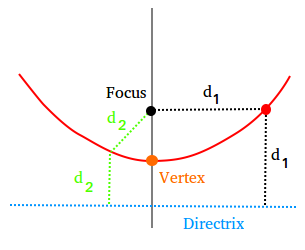
The focus is the black dot. The distance from the orange dot (vertex) to the black dot (focus) is called p.
The distance from the focus (black dot) to the point on the parabola (red dot) is the same as the distance from the point on the parabola (red dot) to the directrix. We use the symbol d1 for both distances to show that the distance is the same.
By the same token,
d2 is the distance from the focus to another point on the parabola
d2 is also the distance from that point on the parabola to the directrix
d2 = d2
Finally, notice that the distance from the focus to the vertex is equal to the distance from the vertex to the directrix.
A point on a parabola is 7 units from the focus. How far is it from the directrix?
Show answer
7 units. Every point on a parabola is the same distance from the focus and from the directrix.
Using the Definition of a Parabola to Find the Equation of a Parabola
Write an equation for a graph that is the set of all points in the plane that are at the same distance from the point (0, 4) and the line y = −4
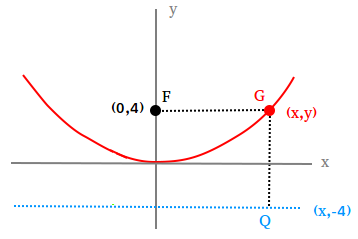
According to the definition, FG = GQ. Therefore, let us find all points G(x, y) such that FG and the distance from G to the line are equal.
FG = √(x − 0)2 + (y − 4)2
FG = √x2 + (y − 4)2
GQ = √(x − x)2 + (y − (−4))2
GQ = √(0)2 + (y + 4)2
GQ = √(y + 4)2
Now set FG = GQ
√x2 + (y − 4)2 = √(y + 4)2
Raise both sides to the second power.
x2 + (y − 4)2 = (y + 4)2
x2 + y2 − 8y + 16 = y2 + 8y + 16
x2 − 8y + 16 = 8y + 16 (Cancel y2)
x2 − 8y = 8y (Cancel 16)
x2 = 8y + 8y
x2 = 16y (equation of a parabola)
y = x216
Squaring (y − 4) as y2 + 16. The middle term is missing: (y − 4)2 = y2 − 8y + 16.
The points of a parabola are the same distance from (0, 2) and the line y = −2. What is its equation?
Show answer
x2 = 8y. The same steps give x2 + (y − 2)2 = (y + 2)2, so x2 − 4y = 4y and x2 = 8y.
How to Derive the Standard Equation of a Parabola When Its Vertex Is at the Origin
In the previous section, the equation of the parabola of all points in the plane that are at the same distance from the point (0, 4) and the line y = −4 was x2 = 16y. Furthermore, the vertex of the parabola was at the origin.
The equation x2 = 16y is in standard form. We can again use the definition of a parabola to find the standard form of the equation of a parabola with its vertex at the origin. Place the focus at the point (0, p). Then, the directrix has an equation given by y = −p.

The point (x, y) is on the parabola if and only if EF = EG
EF = √(x − 0)2 + (y − p)2
EF = √x2 + (y − p)2
EG = √(x − x)2 + (y − (−p))2
EG = √02 + (y + p)2
EG = √(y + p)2
Set EF equal to EG
√x2 + (y − p)2 = √(y + p)2
Raise both sides to the second power
x2 + (y − p)2 = (y + p)2
x2 + y2 − 2yp + p2 = y2 + 2yp + p2
x2 − 2yp = 2yp (Cancel y2 and p2)
x2 − 2yp + 2yp = 2yp + 2yp
x2 = 4yp (Equation of a parabola that opens upward or downward.)
Similarly, we can derive the equation of a parabola with its vertex at the origin. This time though we place the focus at the point (p, 0). Then, the directrix has an equation given by x = −p.
The equation is y2 = 4xp (Equation of a parabola that opens to the right or to the left)
- The equation has the form x2 = 4yp, so the parabola opens upward or downward.
- Match the numbers: 4p = 12, so p = 3.
- The focus is (0, p) = (0, 3).
- The directrix is y = −p, which is y = −3.
Focus (0, 3) and directrix y = −3
What is the focus of the parabola y2 = 20x?
Show answer
(5, 0). The equation has the form y2 = 4xp, and 4p = 20, so p = 5 and the focus is (p, 0) = (5, 0).
How to Derive the Standard Equation of a Parabola When Its Vertex Is Located at (h, k)
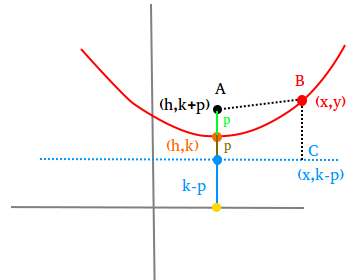
The graph above shows a parabola whose vertex is the orange dot located at (h, k). Recall that p is the distance from the vertex to the focus. Therefore k + p is the y-coordinate of the black dot or the focus.
The y-coordinate of the dashed blue line or directrix is k − p. Why?
Let s be the distance from the yellow dot to the blue dot.
Let p be the distance from the blue dot to the orange dot.
We know that k is the distance from the yellow dot to the orange dot.
k = s + p
s = k − p
According to the definition, AB = BC
AB = √(x − h)2 + [y − (k + p)]2
BC = √(x − x)2 + [y − (k − p)]2
BC = √[y − (k − p)]2
BC = y − (k − p)
Now set AB = BC
√(x − h)2 + [y − (k + p)]2 = y − (k − p)
Raise both sides to the second power
(x − h)2 + [y − (k + p)]2 = [y − (k − p)]2
(x − h)2 + y2 − 2y(k + p) + (k + p)2 = y2 − 2y(k − p) + (k − p)2
(x − h)2 − 2y(k + p) + (k + p)2 = −2y(k − p) + (k − p)2
(x − h)2 − 2yk − 2yp + k2 + 2pk + p2 = −2yk + 2yp + k2 − 2pk + p2
(x − h)2 − 2yp + k2 + 2pk + p2 = 2yp + k2 − 2pk + p2
(x − h)2 − 2yp + k2 + 2pk = 2yp + k2 − 2pk
(x − h)2 − 2yp + 2pk = 2yp − 2pk
(x − h)2 = 4yp − 4pk
(x − h)2 = 4p(y − k)
The equation (x − h)2 = 4p(y − k) above applies when the parabola opens upward or downward with a directrix of y = k − p
If the parabola opens to the right or to the left with a directrix of x = h − p, the equation to use is (y − k)2 = 4p(x − h)
Example: Find the Standard Form of the Equation of a Parabola
Now let us practice.
Example #1: Find the standard form of the equation of a parabola with vertex (3, 1) and focus (3, 6)
Solution
First, notice that when you connect the vertex and the focus, they form a vertical line. This means that the parabola either opens upward or downward.
Therefore, the equation to use is (x − h)2 = 4p(y − k)
Remember that (h, k) are the coordinates of the vertex. So (h, k) = (3, 1)
y = k + p is the y-coordinate of the focus
p = y − k = 6 − 1 = 5
The standard form is (x − 3)2 = 4 × 5(y − 1), so
(x − 3)2 = 20(y − 1)
Find the standard form of the equation of a parabola with vertex (2, −1) and focus (2, 3).
Show answer
(x − 2)2 = 16(y + 1). The vertex and focus form a vertical line, h = 2, k = −1, and p = 3 − (−1) = 4, so 4p = 16 and y − (−1) = y + 1.
Summary
- A parabola is the set of all points the same distance from a fixed point, the focus, and a fixed line, the directrix.
- The vertex is halfway between the focus and the directrix, and p is the distance from the vertex to the focus.
- Vertex at the origin: x2 = 4yp opens upward or downward, and y2 = 4xp opens to the right or to the left.
- Vertex at (h, k): (x − h)2 = 4p(y − k) or (y − k)2 = 4p(x − h).
- To write the equation, find the vertex (h, k) and the distance p from the vertex to the focus.
Test Yourself: Interactive 10-Question Quiz
Now check what you learned. Every answer is explained, and each time you play you get new questions.
Quiz Complete!