What is relative frequency?
Recommended Lessons
Not sure where to start? These are the lessons and games we recommend most to students, parents and teachers on Basic-mathematics.com. Each lesson explains the topic in plain language, walks you through worked examples step by step, and ends with practice so you can check your understanding. Pick one below, or use the menu to find lessons on fractions, algebra, geometry, statistics and more.
In order to find the relative frequency, we will use the frequency distribution table below and the following formula.
To find the relative frequency of a category, divide the frequency of that category by the sum of all frequencies.
We can express the relative frequency with a math formula.
The table below is a frequency table of type of smartphone. Let us find the relative frequency for the categories you see in the able above.
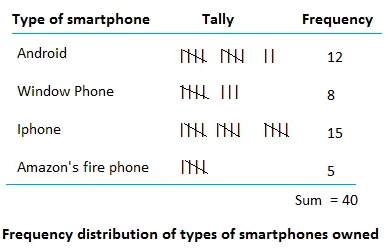
A relative frequency distribution is a table that shows the relative frequency for all categories as shown below.
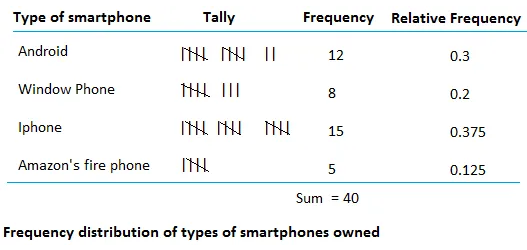
Notice that the sum of the relative frequencies is always equal to 1.
The percentage of a category is found by multiplying the relative frequency of that category by 100.
Percentage of Android phone = 0.3 × 100 = 30%
Relative frequency of Window phone = 0.2 × = 20%
Relative frequency of Iphone = 0.375 × 100 = 37.5%
Relative frequency of Iphone = 0.125 × 100 = 12.5%
Since, the relative frequency of Window phone is 20%, we can conclude 20% of the people in the sample said that they own a Window phone.