What is Function Notation?
Recommended for You
Not sure where to start? These are the lessons and games we recommend most to students, parents and teachers on Basic-mathematics.com. Each lesson explains the topic in plain language, walks you through worked examples step by step, and ends with practice so you can check your understanding. Pick one below, or use the menu to find lessons on fractions, algebra, geometry, statistics and more.
What is function notation? A function is in function notation when you use f(x) instead of y to indicate the outputs. You read f(x) as " f of x " or " f is a function of x "
Sometimes, the domain values (inputs) are related to the range values (outputs) with a rule. For example, take a look at the following situation.
| Input | Function rule | Output |
| 2 | 3 times input + 1 | 7 |
| 3 | 3 times input + 1 | 10 |
You can just use x to represent the inputs and y to represent the outputs and write y = 3 times x + 1.
y = 3x + 1
The notation y = 3x + 1 is one way to write this function. However, as already stated, there is another way. It is the function notation or f(x) = 3x + 1.
Note that f(x) does not mean " f times x "
Suppose that the value of x is 6. You can write f(6) and f(6) is read " f of 6 " or " f is a function of 6 "
f(6) represents the value of the function at x = 6.
For the example above, f(x) = 3x + 1 and f(6) = 3 × 6 + 1 = 18 + 1 = 19
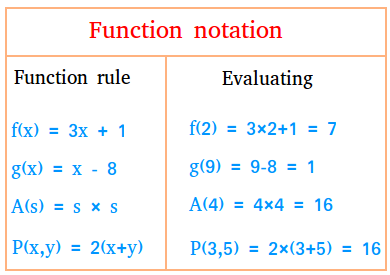
Notice that A(s) = s × s is the function notation for the area of a square.
The different ways we can read A(s) are:
- "A of s"
- "A is a function of s"
- "The area of a square is a function of the side"
Finally, notice from the table above, that the function notation P(x,y) = 2(x + y) has 2 variables. This is quite common when doing advanced math.
What is function notation good for?
There is nothing wrong with the notation y = 3x + 1. However, it has some limitations.
- If you are dealing with more than 1 function, you still have to use y. However, with the function notation, you could use g(x) or h(x) to indicate other functions of x.
- With the notation that uses y, you cannot see the inputs. However, with the function notation, you can see the inputs. For example, when you are looking for the output f(6), you can clearly see that the input is 6.
- You can do composition of functions which you can study in another lesson.
Take a look also at this figure showing what function notation is
Share this page