Calculate a Break-Even Point
In this lesson, you will learn to calculate a break-even point with some carefully chosen word problems.
In this lesson, you will learn
- what a break-even point is, and why revenue equals cost there
- how to write the revenue and the cost from a word problem, using the fixed cost and the variable cost
- how to solve R = C to find the break-even point
- how to use the break-even point formula as a shortcut
What Is a Break-Even Point?
In economics, the break-even point is when you don't make a profit and you don't lose money either. In other words, your revenue or income is equal to your expenses.
Say R = revenue and C = cost.
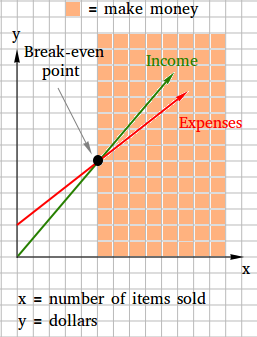
A bakery takes in $6,400 this month, and its expenses are also $6,400. Is the bakery at its break-even point?
Show answer
Yes. Revenue equals cost, so the bakery makes no profit and has no loss.
Example 1: Break-Even Point for Selling Books
It costs a publishing company 50,000 dollars to make books. The 50,000 is a fixed cost, or a cost that does not change with the number of books sold. To help the publishing company sell the books, a marketing company charges 4 dollars for each book sold. If the company charges 9 dollars per book, how many books should they sell to break even?
Solution
Let x be the number of books sold.
Let C be the cost of producing and selling x books.
Let R be the revenue made for selling x books.
Revenue
R = selling price of 1 book × number of books sold
R = 9x
Cost
C = fixed cost + variable cost
variable cost = fee charged for 1 book × number of books sold
variable cost = 4x
C = 50,000 + 4x
Set the revenue equal to the cost
R = C
9x = 50,000 + 4x
9x − 4x = 50,000 + 4x − 4x
5x = 50,000
x = 10,000 since 5 × 10,000 = 50,000
The break-even point is to sell 10,000 books.
Dividing the fixed cost by the selling price: 50,000 ÷ 9 ≈ 5,556 books. That forgets the $4 fee for each book. Each book really brings in only 9 − 4 = 5 dollars toward the fixed cost, so the company needs 50,000 ÷ 5 = 10,000 books.
Suppose the marketing company charges 5 dollars for each book instead of 4. How many books must the publishing company sell to break even?
Show answer
12,500 books. 9x = 50,000 + 5x, so 4x = 50,000 and x = 12,500.
Example 2: Break-Even Point for Selling Hot Dogs
It costs a man 75 dollars to buy the things that he needs to make hot dogs. The city allows him to sell his hot dogs somewhere near the city hall. However, the city hall charges him 1 dollar for each hot dog sold.
Calculate the break-even point if the price he charges for 1 hot dog is $1.50.
Solution
Let x be the number of hot dogs sold.
Let C be the cost of buying and selling x hot dogs.
Let R be the revenue made for selling x hot dogs.
Revenue
R = selling price of 1 hot dog × number of hot dogs sold
R = 1.50x
Cost
C = fixed cost + variable cost
variable cost = fee charged for 1 hot dog × number of hot dogs sold
variable cost = 1x
C = 75 + 1x
Set the revenue equal to the cost
R = C
1.50x = 75 + 1x
1.50x − 1x = 75 + 1x − 1x
0.5x = 75
x = 150 since 0.5 × 150 = 75
The break-even point is to sell 150 hot dogs.
Multiplying instead of dividing at the last step. From 0.5x = 75, the answer is not 0.5 × 75 = 37.5. Divide both sides by 0.5: x = 75 ÷ 0.5 = 150. Dividing by a number less than 1 gives a bigger number.
The man raises his price to $2.00 per hot dog. How many hot dogs must he sell now to break even?
Show answer
75 hot dogs. 2x = 75 + 1x, so x = 75. Each hot dog now brings in $1 toward the $75.
Calculate the Break-Even Point Using a Formula
A break-even point formula can be derived, and you can just use the formula to calculate the break-even point quicker.
Deriving the formula
C = fixed cost + variable cost
Let x be the number of items sold, and let c (lowercase c) be the fee charged for each item sold.
Variable cost = fee charged for each item sold × number of items sold
Variable cost = c × x
C = fixed cost + cx
Let s be the selling price of one item.
R = s × x
R = C
sx = fixed cost + cx
sx − cx = fixed cost + cx − cx
sx − cx = fixed cost
x(s − c) = fixed cost
Divide both sides of the equation by s − c.
In Example 2, fixed cost = $75, s = $1.50, and c = $1. To calculate the break-even point, just put these numbers into the formula.
Example 2 with the formula
x = 751.50 − 1
x = 750.50 = 150
s − c is the money each item brings in after paying its own cost. The break-even point is how many items it takes to pay the whole fixed cost.
If the formula gives a decimal, round up to the next whole number: you can't sell part of an item, and rounding down would leave a small loss.
- Fixed cost = $1,200, s = $15 and c = $7.
- Each shirt brings in s − c = 15 − 7 = $8 toward the fixed cost.
- x = 1,2008 = 150
- Check: revenue = 15 × 150 = $2,250, and cost = 1,200 + 7 × 150 = $2,250. They are equal.
The club must sell 150 shirts to break even.
The fixed cost is $600. Each item costs $2 to make and sells for $5. What is the break-even point?
Show answer
200 items. x = 600 ÷ (5 − 2) = 600 ÷ 3 = 200.
Summary
- At the break-even point, revenue equals cost: R = C. There is no profit and no loss.
- Revenue is the selling price times the number sold: R = sx.
- Cost is the fixed cost plus the variable cost: C = fixed cost + cx.
- Solve sx = fixed cost + cx, or use the formula x = fixed cost ÷ (s − c).
- If the answer is a decimal, round up. Each item sold after the break-even point adds s − c dollars of profit.
Practice: Solve 5 Break-Even Point Problems
Problems 1 and 2 guide you through every step. Problem 3 has fewer steps, and problems 4 and 5 give only the key steps. You can skip a problem at any time, and each time you play you get new problems.