Factoring Using the Box Method
In this lesson, you will learn
- How to set up the box for a trinomial ax2 + bx + c
- How to find the two middle terms that go in the box
- How to read the factors from the greatest common factors of the rows and columns
- Why you should factor out the greatest common factor of a, b and c first
What is the box method?
Factoring using the box method is probably the best way to factor a trinomial of the form ax2 + bx + c.
The box is just a 2 × 2 square that we put the terms of the trinomial in.
The box method in 3 steps:
- Put the first term (ax2) in the top-left square and the last term (c) in the bottom-right square.
- Multiply the first term by the last term. Find two terms that multiply to this product and add up to the middle term (bx). Put them in the two empty squares.
- Write the greatest common factor of each row on the left and of each column on the top. These give the two factors.
Example #1: factor 2x2 + 9x + 10
Factor 2x2 + 9x + 10 using the box method.
Step 1
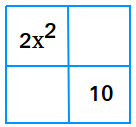
First, put 2x2 and 10 in the box below as shown. You will always put the first term in the first row and the first column and the last term in the second row and second column.
Step 2
Multiply the first term by the last term: 2x2 × 10 = 20x2
Look for factors of 20x2 that will add up to the second term or 9x.
20x2 = 1x × 20x
20x2 = 2x × 10x
20x2 = 4x × 5x
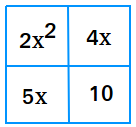
Since 4x and 5x add up to 9x, put 4x and 5x in the box.
Step 3
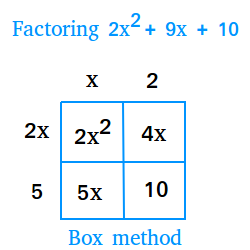
Find the greatest common factor of each row and write them down on the left or right side of the box. Then, find the greatest common factor of each column and write them down on top or at the bottom of the box.
Notice the following:
2x times x = 2x2
2x times 2 = 4x
5 times x = 5x
5 times 2 = 10
The factors are (2x + 5) and (x + 2), so 2x2 + 9x + 10 = (2x + 5)(x + 2)
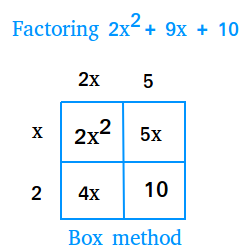
4x and 5x are interchangeable, so you could put 5x in the first row and 4x in the second row and still get the same answer.
To factor 3x2 + 7x + 2, which two terms go in the empty squares of the box?
Show answer
6x and x. 3x2 × 2 = 6x2, and 6x × x = 6x2 while 6x + x = 7x.
A common pitfall to avoid when factoring using the box method
When factoring using the box method, you need to make sure that the greatest common factor of a, b, and c in ax2 + bx + c is equal to 1, as example #2 shows.
Example #2: factor 6x2 + 27x + 30
Factor 6x2 + 27x + 30 using the box method.
Step 1
First, put 6x2 and 30 in the box.
Step 2
Multiply the first term by the last term: 6x2 × 30 = 180x2
Look for factors of 180x2 that will add up to 27x.
Since 12x × 15x = 180x2 and 12x + 15x = 27x, put 12x and 15x in the box.
Step 3
Find the greatest common factor of each row and write them down on the left or right side of the box. Then, find the greatest common factor of each column and write them down on top or at the bottom of the box. We end up with the following box.
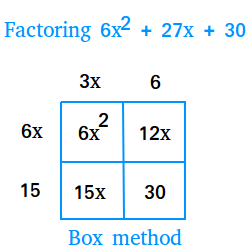
However, we have a little problem. 6x times 3x is not equal to 6x2, 6x times 6 is not equal to 12x, 15 times 3x is not equal to 15x, and 15 times 6 is not equal to 30.
In order for us to see what happened here, we need to make an important observation.
Notice that 6x2 + 27x + 30 = 3(2x2 + 9x + 10) and we already factored 2x2 + 9x + 10.
Therefore, 6x2 + 27x + 30 = 3(2x2 + 9x + 10) = 3(2x + 5)(x + 2)
Looking at the box immediately above again, we see that we can factor 3 out of the entire thing. And if we do that, we will get the same answer as illustrated below.
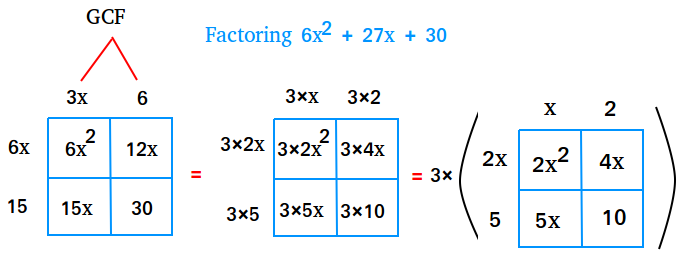
Look at the image immediately above again. The box inside the parentheses is the box that we used to factor 2x2 + 9x + 10.
Therefore, when factoring using the box method, make sure you factor the trinomial ax2 + bx + c until the greatest common factor of a, b, and c is equal to 1 to avoid complicating things.
What should you do first to factor 5x2 + 15x + 10 with the box method?
Show answer
Factor out 5. The greatest common factor of 5, 15 and 10 is 5, so 5x2 + 15x + 10 = 5(x2 + 3x + 2). Then use the box on x2 + 3x + 2.
Example #3: factor 4x2 − 8x − 12
Factor 4x2 − 8x − 12 using the box method.
First, factor 4x2 − 8x − 12 using the greatest common factor.
Now, you just need to factor x2 − 2x − 3 using the box method.
Step 1
First, put x2 and −3 in the box.
Step 2
Multiply the first term by the last term: x2 × −3 = −3x2
Look for factors of −3x2 that will add up to −2x.
Since −3x × x = −3x2 and −3x + x = −2x, put −3x and x in the box.
Step 3
Find the greatest common factor of each row and write them down on the left or right side of the box. Then, find the greatest common factor of each column and write them down on top or at the bottom of the box. We end up with the following box.
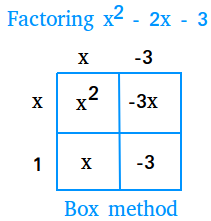
x2 − 2x − 3 = (x + 1)(x − 3)
4x2 − 8x − 12 = 4(x2 − 2x − 3) = 4(x + 1)(x − 3)
One more example: a negative last term
- The greatest common factor of 3, 5 and −2 is 1, so we can use the box right away.
- Put 3x2 in the top-left square and −2 in the bottom-right square.
- Multiply: 3x2 × −2 = −6x2. We need two terms that multiply to −6x2 and add up to 5x: 6x × (−x) = −6x2 and 6x + (−x) = 5x. Put 6x in the first row and −x in the second row.
- Row 1 (3x2 and 6x): the greatest common factor is 3x. Row 2 (−x and −2): take out −1.
- Column 1 (3x2 and −x): the greatest common factor is x. Column 2 (6x and −2): the greatest common factor is 2.
- Check: 3x · x = 3x2, 3x · 2 = 6x, −1 · x = −x and −1 · 2 = −2. Every square matches.
3x2 + 5x − 2 = (3x − 1)(x + 2)
When both terms in a row are negative, take out a negative common factor. Then multiply each side factor by each top factor to check that you get every term in the box.
Factor x2 + 4x − 5 using the box method.
Show answer
(x + 5)(x − 1). x2 × −5 = −5x2; 5x × (−x) = −5x2 and 5x + (−x) = 4x.
Watch the video
Need a little more help? Watch the video and follow along one box at a time.
Summary
- First, factor out the greatest common factor of a, b and c, so that it is equal to 1.
- Put ax2 in the first row and first column and c in the second row and second column.
- Multiply ax2 by c, then find two terms with that product that add up to bx. They fill the two empty squares.
- The greatest common factors of the rows and of the columns are the two factors.
- Check by multiplying: each side factor times each top factor must give the term in that square.
Test Yourself: 10-Question Quiz
Now check what you learned. Every answer is explained, and each time you play you get new questions.
Quiz Complete!