Fraction Wall: Interactive Fraction Bars
A fraction wall, also called fraction bars or a fraction strip chart, shows one whole split into halves, thirds, fourths and more, stacked so you can compare the pieces. Use this interactive fraction wall to shade fractions, find equivalent fractions, compare two fractions and add fractions.
In this lesson, you will learn
- how to read a fraction wall
- how to find equivalent fractions by lining up the pieces
- how to compare two fractions and tell which one is greater
- how to add fractions by putting pieces end to end
Interactive Fraction Wall
Pick a mode, then click or tap the pieces. You can also use the keyboard: Tab to a piece and press Enter.
How to Use a Fraction Wall
Every row of a fraction wall is the same length: one whole. The top row is the whole itself. The next row is cut into 2 equal pieces (halves), the next into 3 equal pieces (thirds), and so on.
A fraction wall is a chart of rows of equal length, where each row is one whole divided into equal pieces. A row cut into 4 pieces shows fourths: each piece is 14.
The more pieces a row has, the smaller each piece is. 18 is smaller than 14 because the whole is cut into more pieces.
Equivalent fractions line up
Two fractions are equivalent when they cover the same length of the wall. Shade the pieces in different rows and look for shaded parts that end at the same place.
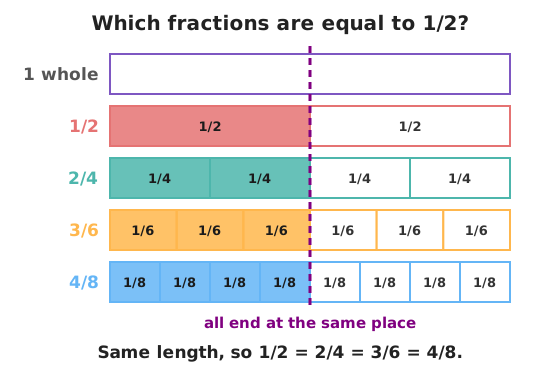
If the shaded parts of two rows end at the same place, the fractions are equivalent. If one ends farther to the right, that fraction is greater.
- In the thirds row, shade 2 pieces.
- In the fifths row, shade 3 pieces.
- The shaded part of the thirds row ends farther to the right.
- Check by cross multiplying: 2 × 5 = 10 and 3 × 3 = 9. Since 10 > 9, 23 is greater.
23 > 35
Adding fractions on the wall
Put pieces end to end. For example, 12 + 14 ends at the same place as 3 fourths, so 12 + 14 = 34. Try it in the Add mode above.
Thinking that a bigger denominator means a bigger fraction. On the wall, the eighths row has more pieces than the fourths row, so each eighth is smaller than each fourth.
Use the wall: how many twelfths make 23?
Show answer
8 twelfths. The shaded part for 2 thirds ends at the same place as 8 twelfths, so 23 = 812.
Summary
- Every row of a fraction wall is one whole, cut into equal pieces.
- More pieces in a row means smaller pieces.
- Fractions are equivalent when their shaded parts end at the same place, like 1/2 = 2/4 = 3/6.
- The fraction whose shaded part reaches farther to the right is greater.
- To add fractions, put the pieces end to end and see where they stop.
Test Yourself: Interactive 10-Question Quiz
Now check what you learned. Use the fraction wall above if it helps. Every answer is explained with fraction bars, and each time you play you get new questions.