Word Problems Involving Quadratic Equations

Recommended for You

Not sure where to start? These are the lessons and games we recommend most to students, parents and teachers on Basic-mathematics.com. Each lesson explains the topic in plain language, walks you through worked examples step by step, and ends with practice so you can check your understanding. Pick one below, or use the menu to find lessons on fractions, algebra, geometry, statistics and more.

Many real situations lead to quadratic equations: areas of rectangles, pairs of numbers, costs, and objects thrown into the air. To solve a word problem involving a quadratic equation, turn the words into an equation, solve it, and then check which answers make sense in the situation. Most of the equations here are solved by factoring.

Interesting word problems involving quadratic equations

Reveal each solution one step at a time, or show all the steps at once.

Problem 1: A rectangular garden

A rectangular garden has an area of 14 square meters and a perimeter of 18 meters. Find the length and the width of the garden.
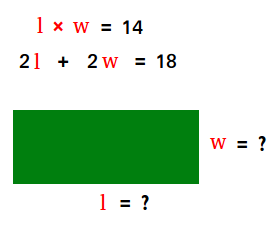
Rectangular garden word problem: l × w = 14 and 2l + 2w = 18. Find the length l and the width w.
The garden: its area is l × w = 14 and its perimeter is 2l + 2w = 18.
Name the unknowns. lwArea = 14 m² Perimeter = 18 m Let w be the width and l the length, both in meters.
Write what you know.2l + 2w = 18  and  lw = 14
Write the length in terms of the width.Divide the perimeter equation by 2, then subtract w from both sides.(2l + 2w) ÷ 2 = 18 ÷ 2
l + w = 9
l + w − w = 9 − w
l = 9 − w
Now the length can be labeled 9 − w. 9 − wwArea = 14 m² Perimeter = 18 m
Write one equation in w.w(9 − w) = 14Replace l with 9 − w in the area equation.
Standard form.Multiply out the left side. Then add w² and subtract 9w on both sides, so that the w² term ends up positive.w(9 − w) = 14
9w − w² = 14
9w − w² + w² − 9w = 14 + w² − 9w
0 = w² − 9w + 14
w² − 9w + 14 = 0
Set up the boxes.w² − 9w + 14 = (w + )(w + )The numbers must multiply to 14 and add to −9. A quick look at the pairs is enough: −2 + (−7) = −9.
Show the cross-multiplication table
TryCross multiply and add
ww11414w + w = 15w
ww−1−14−14w − w = −15w
ww277w + 2w = 9w
ww−2−7−7w − 2w = −9w ✓
Factor and solve.(w − 2)(w − 7) = 0  →  w = 2  or  w = 7
Which answer makes sense?Both. If the width is 2 m, the length is 9 − 2 = 7 m. If the width is 7 m, the length is 2 m. It's the same garden turned sideways.
Answer.The garden is 7 m by 2 m.Check: area 7 · 2 = 14 m² and perimeter 2(7) + 2(2) = 18 m ✓
Problem 2: Two numbers

The sum of two numbers is 12 and their product is 35. Find the two numbers.

Name the unknowns.Let m and n be the two numbers.
Write what you know.m + n = 12  and  mn = 35
Write one number in terms of the other.Subtract m from both sides of the sum equation.m + n − m = 12 − m
n = 12 − m
Write one equation in m.m(12 − m) = 35Replace n with 12 − m in the product equation.
Standard form.Multiply out the left side. Then add m² and subtract 12m on both sides.m(12 − m) = 35
12m − m² = 35
12m − m² + m² − 12m = 35 + m² − 12m
0 = m² − 12m + 35
m² − 12m + 35 = 0
Set up the boxes.m² − 12m + 35 = (m + )(m + )The numbers must multiply to 35 and add to −12. A quick look: −5 + (−7) = −12.
Show the cross-multiplication table
TryCross multiply and add
mm13535m + m = 36m
mm−1−35−35m − m = −36m
mm577m + 5m = 12m
mm−5−7−7m − 5m = −12m ✓
Factor and solve.(m − 5)(m − 7) = 0  →  m = 5  or  m = 7
Find the other number.If m = 5, then n = 12 − 5 = 7. If m = 7, then n = 5. Either way, the two numbers are the same pair.
Answer.The numbers are 5 and 7.Check: 5 + 7 = 12 and 5 · 7 = 35 ✓
Problem 3: The lowest production cost

A company's cost of producing x tires is C = 0.00002x² − 0.04x + 38. How many tires should it produce to make the cost as low as possible?

What is the question asking?Not every quadratic word problem asks you to solve an equation. Here you need the value of x that makes C as small as possible.
Look at the shape of the graph.a = 0.00002 > 0C is quadratic in x, and a is positive, so the graph is a parabola that opens upward. Its lowest point, the vertex, gives the lowest cost.
Find the vertex.x = −b ÷ 2a = 0.04 ÷ (2 · 0.00002) = 0.04 ÷ 0.00004 = 1,000Here b = −0.04, so −b = 0.04.
Answer.Produce 1,000 tires.At 1,000 tires the cost is C = 0.00002(1,000)² − 0.04(1,000) + 38 = 20 − 40 + 38 = 18, the lowest possible.
Problem 4: The largest frame

A 9-foot strip of wood is used to frame a rectangular collage. What length and width give the collage the largest possible area?

Name the unknowns. lw The 9-ft strip goes all the way around Let w be the width and l the length, both in feet.
The strip goes all the way around.The strip is the perimeter, so 2l + 2w = 9. Divide both sides by 2, then subtract w from both sides.(2l + 2w) ÷ 2 = 9 ÷ 2
l + w = 4.5
l + w − w = 4.5 − w
l = 4.5 − w
Now the length can be labeled 4.5 − w. 4.5 − ww The 9-ft strip goes all the way around
Write the area.Area is width × length. Multiply out, then write the w² term first.A = w(4.5 − w)
A = 4.5w − w²
A = −w² + 4.5w
Look at the shape of the graph.a = −1 < 0The parabola opens downward, so its highest point, the vertex, gives the largest area.
Find the vertex.w = −b ÷ 2a = −4.5 ÷ (2 · (−1)) = 2.25
Find the length.l = 4.5 − 2.25 = 2.25
Answer.A square, 2.25 ft by 2.25 ft.The largest area is 2.25 · 2.25 = 5.0625 square feet.
Problem 5: Consecutive integers

The product of two consecutive positive integers is 132. Find the integers.

Name the unknowns.Let n be the smaller integer. The next integer is n + 1.
Write the equation.n(n + 1) = 132
Standard form.Multiply out the left side, then subtract 132 from both sides.n(n + 1) = 132
n² + n = 132
n² + n − 132 = 132 − 132
n² + n − 132 = 0
Set up the boxes.n² + n − 132 = (n + )(n + )The numbers must multiply to −132 and add to 1. Look for two factors of 132 that are 1 apart: 11 and 12. So the pair is 12 and −11.
Show the cross-multiplication table
TryCross multiply and add
nn1−132−132n + n = −131n
nn−1132132n − n = 131n
nn2−66−66n + 2n = −64n
nn−26666n − 2n = 64n
nn3−44−44n + 3n = −41n
nn−34444n − 3n = 41n
nn4−33−33n + 4n = −29n
nn−43333n − 4n = 29n
nn6−22−22n + 6n = −16n
nn−62222n − 6n = 16n
nn11−12−12n + 11n = −n
nn−111212n − 11n = n ✓
Factor and solve.(n + 12)(n − 11) = 0  →  n = −12  or  n = 11
Which answer makes sense?The problem asks for positive integers, so n = −12 is out.
Answer.The integers are 11 and 12.Check: 11 · 12 = 132 ✓
Problem 6: A ball thrown upward

A ball is thrown straight up. Its height after t seconds is h = −16t² + 64t feet. When is the ball 48 feet above the ground?

Write the equation.−16t² + 64t = 48Set the height equal to 48.
Standard form.Subtract 48 from both sides. Then divide every term by −16, which makes the numbers smaller and the t² term positive.−16t² + 64t = 48
−16t² + 64t − 48 = 48 − 48
−16t² + 64t − 48 = 0
(−16t² + 64t − 48) ÷ (−16) = 0 ÷ (−16)
t² − 4t + 3 = 0
Set up the boxes.t² − 4t + 3 = (t + )(t + )The numbers must multiply to 3 and add to −4: −1 + (−3) = −4.
Show the cross-multiplication table
TryCross multiply and add
tt133t + t = 4t
tt−1−3−3t − t = −4t ✓
Factor and solve.(t − 1)(t − 3) = 0  →  t = 1  or  t = 3
Which answer makes sense?Both. The ball passes 48 feet twice: once on the way up, after 1 second, and once on the way down, after 3 seconds.
Answer.At 1 second and at 3 seconds.Check: −16(1)² + 64(1) = 48 ✓ and −16(3)² + 64(3) = −144 + 192 = 48 ✓

Your turn

Solve this problemSolved: 0

Step 1

Which equation matches the problem?

Common mistakes

  • Keeping an answer that doesn't make sense. A length, a width or an age can't be negative. If the problem says positive, drop the negative solution.
  • Throwing away an answer that does make sense. In the ball problem, both times are correct: the ball passes 48 feet on the way up and on the way down.
  • Using the whole perimeter as length + width. The perimeter counts each side twice, so length + width is half the perimeter.
  • Factoring before the equation equals 0. w(9 − w) = 14 doesn't mean w = 14 or 9 − w = 14. Move every term to one side first.
  • Writing the wrong expression for "consecutive." Consecutive integers are n and n + 1. Consecutive even or odd integers are n and n + 2.
  • Answering only part of the question. If the problem asks for the length and the width, give both, with units.

If you found the word problems involving quadratic equations on this lesson difficult to understand, review the lesson about factoring trinomials