Write an Exponential Function
Recommended Lessons
Not sure where to start? These are the lessons and games we recommend most to students, parents and teachers on Basic-mathematics.com. Each lesson explains the topic in plain language, walks you through worked examples step by step, and ends with practice so you can check your understanding. Pick one below, or use the menu to find lessons on fractions, algebra, geometry, statistics and more.
Writing an Exponential Function From Two Points
In this lesson, you will learn
- the general form of an exponential function, y = abx
- how to use two points on the graph to find a and b
- how to work with a negative exponent and a fraction for b
You can write an exponential function from two points on the function's graph. For example, write an exponential function y = abx for a graph that includes (1, 1) and (2, 4).
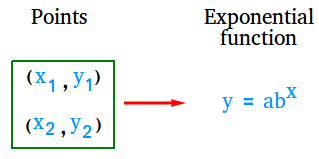
The General Form and the Method
The goal is to use the two given points to find a and b. Then, we can replace a and b in the equation y = abx with the values we found.
1. Substitute the first point into y = abx and solve for a.
2. Substitute the second point into y = abx.
3. Replace a with what you found in step 1, and solve for b.
4. Use b to find a, then write y = abx with the values of a and b.
In an exponential function, b is always positive and not equal to 1. So if you get b² = 9, then b = 3, not −3.
What is y in y = 3(2)x when x = 2?
Show answer
y = 12. 3 × 2² = 3 × 4 = 12.
Example #1
(1, 1) and (2, 4)
- Use the general form of the exponential function y = abx and substitute for x and y using (1, 1).1 = ab11 = ab
- Divide both sides by b to solve for a.a = 1b
- Use the general form of the exponential function y = abx again and substitute for x and y using (2, 4).4 = ab2
- Substitute 1b for a in 4 = ab2.4 = 1b × b24 = b2b4 = b
- Find a.a = 1b = 14
The exponential function is y = (1/4)(4)x
Check the answer: what is y in y = (1/4)(4)x when x = 3?
Show answer
y = 16. (1/4) × 4³ = (1/4) × 64 = 16, so (3, 16) is also on the graph.
A More Complicated Example Showing How to Write an Exponential Function
(1, 2) and (−1, 8)
- Use the general form of the exponential function y = abx and substitute for x and y using (1, 2).2 = ab12 = ab
- Divide both sides by b to solve for a.a = 2b
- Use the general form of the exponential function y = abx again and substitute for x and y using (−1, 8).8 = ab−1
- Substitute 2b for a in 8 = ab−1.8 = 2b × b−1
- Multiply both sides of the equation by b2.b2 × 8 = 2b × b−1 × b2b2 × 8 = 2b × bb2 × 8 = 2
- Divide both sides of the equation by 8.(b2 × 8) / 8 = 2 / 8b2 = 28 = 14
- Take the square root.b = square root of 14 = 12b must be positive, so we use 1/2, not −1/2.
- Now, let us find a using the equation a = 2 / b.a = 2 ÷ 12 = 21 × 21 = 41 = 4
The exponential function is y = 4(1/2)x
Forgetting what a negative exponent means. b−1 is 1b, not −b. For example, 4−1 = 14.
A graph of y = abx includes (0, 5) and (1, 15). What is the function?
Show answer
y = 5(3)x. At x = 0, b0 = 1, so 5 = a. Then 15 = 5b, so b = 3.
Summary
- An exponential function has the form y = abx, with b positive and not equal to 1.
- Substitute each point into y = abx to get two equations.
- Solve the first equation for a, put it into the second, and solve for b. Then find a.
- A negative exponent means a fraction: b−1 = 1/b.
- If one point has x = 0, then a is its y-value, because b0 = 1.
Test Yourself: 10-Question Quiz
Now check what you learned. Every answer is explained, and each time you play you get new numbers.
Quiz Complete!