Key Words in Math Word Problems
Key words in math word problems are words such as total, more, left and each that often point to an operation: add, subtract, multiply or divide. Key words are useful clues, but they can also trick you. The same word can mean different operations in different problems, and many problems have no key words at all. This lesson gives you the key word list, shows you the traps, and teaches a method that works even when the key words don't.
In this lesson, you will learn
- The most common key words for addition, subtraction, multiplication and division
- Why words like "more," "left," "total" and "each" can lead you to the wrong operation
- A 4-step method to choose the operation without relying on key words
- How to spot extra numbers and hidden steps, and how to check your answer
Key Words for Addition, Subtraction, Multiplication and Division
Here are the key words you will see most often in math word problems. Each word is listed with the operation it usually means.
- Addition (+)sum, total, in all, altogether, combined, plus, increased by, more than, added to, both
- Subtraction (−)difference, minus, less than, fewer than, decreased by, take away, left, remain, how many more
- Multiplication (×)product, times, of, each, per, every, double, twice, triple, groups of
- Division (÷)quotient, share, split, divided by, per, each, equally, half, average, groups of
Look closely and you will notice that some words appear under two operations. Each, per and groups of show up for both multiplication and division. That is your first hint that a key word alone cannot tell you what to do.
A key word is a word in a word problem that often goes with one operation. A key word is a clue, not a rule: you still have to understand the whole problem before you choose the operation.
In the list above, which key words appear under more than one operation?
Show answer
Each, per and groups of. They appear under both multiplication and division, so the word alone cannot tell you which one to use.
Keyword Traps: When Key Words Mislead You
A keyword trap is a word problem where the key word points to the wrong operation. The picture below shows two problems that both use the word "more." In the first one you add. In the second one you subtract.
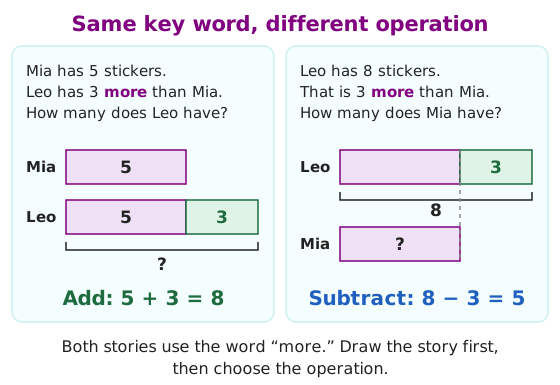
Here are the most common keyword traps. In each row, the key word suggests one operation, but the problem needs another one.
| Key word | Usually means | Trap problem | What you really do |
|---|---|---|---|
| more | add | Jen has 12 cards. That is 4 more than Ali has. How many cards does Ali have? | Subtract: 12 − 4 = 8 |
| fewer / less | subtract | Tom has 7 stamps. That is 5 fewer than Ruth has. How many stamps does Ruth have? | Add: 7 + 5 = 12 |
| left | subtract | Sam gave away 6 marbles and has 14 left. How many marbles did he have at first? | Add: 14 + 6 = 20 |
| total | add | There are 5 boxes with 8 pens in each box. How many pens are there in total? | Multiply: 5 × 8 = 40 |
| total | add | A class has 28 students in total. 13 are boys. How many are girls? | Subtract: 28 − 13 = 15 |
| each | multiply | 24 stickers are shared by 4 friends. How many stickers does each friend get? | Divide: 24 ÷ 4 = 6 |
| times | multiply | Dad is 36. That is 3 times as old as Eva. How old is Eva? | Divide: 36 ÷ 3 = 12 |
| altogether | add | Grace has 18 pencils altogether in 3 cases, the same number in each case. How many pencils are in each case? | Divide: 18 ÷ 3 = 6 |
Notice the pattern. When a sentence gives you the result of a comparison or a change ("12 is 4 more than Ali has," "has 14 left"), you usually have to work backward and use the opposite operation.
Seeing "more" and adding right away. In "Jen has 12 cards. That is 4 more than Ali has," Jen has more cards, so Ali has fewer: 12 − 4 = 8. Ask yourself who has more before you choose the operation.
Ana has 20 shells. That is 6 fewer than Ben has. How many shells does Ben have?
Show answer
26 shells. Ana has fewer shells, so Ben has more: 20 + 6 = 26. The key word "fewer" suggests subtraction, but you add.
For printable practice with these traps, use the key words word problems worksheet. Each worksheet comes with an answer key.
Interactive Explorer: Same Key Word, Different Operation
Pick a key word. You will see two problems that use the same word. Choose the operation for each problem and see why.
How to Choose the Operation Without Key Words: A 4-Step Method
Researchers who study word problems have found that teaching students to recognize the type of problem works better than teaching key words. Here is a simple method that uses that idea.
- Read the whole problem and retell the story in your own words, without numbers. What is happening?
- Find the question. What exactly are you looking for? Underline the question, not the key words.
- Decide the problem type with the table below. Write an equation with a blank for the unknown.
- Solve and check. Does the answer make sense in the story? Is it bigger or smaller than it should be?
| Problem type | Ask yourself | Equation | Example |
|---|---|---|---|
| Total | Are parts put together into a total? | part + part = total | 8 red apples and some green apples make 15 apples. |
| Difference | Am I comparing two amounts? | bigger − smaller = difference | Ken has 15 books and Lia has 9. |
| Change | Does a starting amount go up or down? | start ± change = end | Sam had some marbles, gave away 6 and has 14 left. |
| Equal groups | Are there groups with the same number in each? | groups × number in each = total | 5 boxes with 8 pens in each box. |
| Comparison (times) | Is one amount a number of times another? | times × smaller amount = bigger amount | Dad is 36, which is 3 times as old as Eva. |
The equation shows the structure of the story. The operation comes from the equation, not from a key word. For example, the change equation start − 6 = 14 is solved by adding: start = 14 + 6.
- Retell the story: the baker started with some muffins, sold some, and some are left.
- The question: how many muffins did she have at the start?
- Problem type: a starting amount goes down, so it is a change problem. Equation: start − 27 = 18.
- Solve: start = 18 + 27 = 45. Check: 45 − 27 = 18, and 45 is more than 18, which makes sense because she started with more than she has now.
The baker made 45 muffins. The key word "left" suggests subtraction, but you add.
Which problem type is this? "Each shelf holds 9 books. There are 7 shelves. How many books are there?"
Show answer
Equal groups. There are 7 groups (shelves) with 9 in each group: 7 × 9 = 63 books.
Multi-Step Problems and Extra Numbers
Why key words fail in multi-step problems
In a multi-step problem, you need two or more operations. A key word can only point to one of them, and it does not tell you the order.
Movie tickets cost $12 each and popcorn costs $5 per bag. Three friends each buy one ticket and one bag of popcorn. How much do they pay in total?
One friend pays 12 + 5 = $17.
Three friends pay 3 × 17 = $51.
The key word "total" suggests adding 12 + 5 + 3 = 20, which is wrong. The word "each" hides the second step: the same amount is paid 3 times.
Watch out for extra numbers
Some word problems give you numbers you do not need. A key word strategy makes you want to use every number. Understanding the story tells you which numbers matter.
Lily is 10 years old. She buys 4 packs of markers with 6 markers in each pack. How many markers does she buy?
Lily's age does not matter: 4 × 6 = 24 markers.
Using every number in the problem. Before you calculate, ask which numbers the question really needs. In the marker problem, the 10 is extra information.
A pizza costs $9 and a drink costs $2. Four friends each buy a pizza and a drink. How much do they pay altogether?
Show answer
$44. One friend pays 9 + 2 = $11, so four friends pay 4 × 11 = $44.
How to Check That Your Answer Makes Sense
The fastest way to catch a keyword trap is to check your answer against the story. Use these three quick checks.
- Bigger or smaller?Should the answer be bigger or smaller than the numbers in the problem? If Ali has fewer cards than Jen, Ali's answer must be smaller than Jen's 12.
- EstimateRound the numbers and solve again in your head. 27 + 18 is about 30 + 20 = 50, so 45 is reasonable.
- Work backwardPut your answer back into the story. If the baker made 45 muffins and sold 27, she has 18 left. That matches.
If your answer does not fit the story, you probably chose the wrong operation. Go back to step 1 and retell the story.
Frequently Asked Questions About Key Words in Word Problems
What is a "keyword trap" in a math word problem?
A keyword trap is a problem where a common key word points to the wrong operation. For example, "Jen has 12 cards. That is 4 more than Ali has" uses "more," but you subtract to find Ali's cards: 12 − 4 = 8.
Why doesn't "more" always mean add?
"More" describes a comparison, and you can be asked for either amount. If you know the smaller amount and want the bigger one, you add. If you know the bigger amount and want the smaller one, or the difference, you subtract. "How many more?" is a subtraction question.
Why doesn't "less" always mean subtract?
"Tom has 7 stamps. That is 5 fewer than Ruth has." Tom has less, so Ruth has more: 7 + 5 = 12. When you know the smaller amount and want the bigger one, "less" or "fewer" leads to addition.
Does "each" always mean multiply?
No. "5 boxes with 8 pens in each" is multiplication, because you know the number in each group. But "24 stickers shared by 4 friends. How many does each get?" is division, because "each" is what you are looking for.
Does "share" always mean divide?
Usually, but not always. "Each of 6 friends gets a share of 4 cookies. How many cookies were there?" is multiplication: 6 × 4 = 24. Look at what you know and what you want.
What does "of" mean in word problems, and why is it tricky?
With fractions and percents, "of" means multiply: 14 of 20 = 14 × 20 = 5. But "of" is also an ordinary word: "3 of the 20 students are absent. How many are present?" is subtraction: 20 − 3 = 17. To learn more, see what does “of” mean in math.
Why does the order matter in "more than" and "less than"?
"5 less than 12" means 12 − 5, not 5 − 12. The number after "than" is the starting amount, so it comes first. With addition the order doesn't change the answer, but with subtraction it does.
What's the difference between "how many more" and "how many in all"?
"How many more" compares two amounts, so you subtract: 15 − 9 = 6 more books. "How many in all" puts amounts together, so you usually add: 15 + 9 = 24 books in all. With equal groups, "in all" means multiply.
Does "left" always mean subtract?
No. "How many are left?" after giving some away is subtraction. But when the problem tells you how many are left and asks how many there were at first, you add: 14 left + 6 given away = 20 at first.
Why do word problems sometimes give extra numbers you don't need?
Real situations contain extra information, and extra numbers test whether you understand the story. If you only hunt for key words and numbers, you will try to use all of them. Ask which numbers the question needs.
What are the first 3 things to do before choosing an operation?
Read the whole problem and retell the story in your own words. Find the question and what it asks for. Decide the problem type: total, difference, change or equal groups. Then write an equation.
Should I underline or circle key words in word problems?
Underlining the question is more useful than circling key words. Key words can still help you notice what is happening, but always check them against the whole story before you choose an operation.
Is the CUBES strategy a keyword trap?
CUBES stands for Circle the numbers, Underline the question, Box the key words, Evaluate (or eliminate extra information) and Solve. It becomes a trap when "Box the key words" turns into "pick the operation from the key word." Use the boxed words as clues, then decide the problem type before solving.
What should I do if I chose the wrong operation?
Check your answer against the story. Is it too big or too small? Does it work when you put it back into the problem? If not, retell the story, decide the problem type again and write a new equation.
How can I tell if my answer makes sense?
Estimate with rounded numbers, check whether the answer should be bigger or smaller than the given numbers, and work backward by putting your answer into the story.
Why do multi-step word problems make key words unreliable?
A multi-step problem needs two or more operations in the right order. One key word cannot tell you all the operations or their order, and the words that matter, like "each," may point to a hidden step.
Summary
- Key words such as total, more, left, each and share often point to an operation, but they are clues, not rules.
- The same key word can mean different operations. "More" can mean add or subtract, and "each" can mean multiply or divide.
- When a sentence tells you the result of a comparison or a change, you often need the opposite operation.
- To choose the operation, retell the story, find the question, decide the problem type (total, difference, change, equal groups or comparison) and write an equation.
- In multi-step problems and problems with extra numbers, key words are especially unreliable.
- Always check that your answer makes sense: estimate, compare sizes and work backward.
Test Yourself: Interactive 10-Question Quiz
Now check what you learned. Each question is a word problem: choose the expression that solves it. Some key words will help you and some will try to trick you. Every answer is explained, and each time you play you get new questions.
Quiz complete!