Practice Key Words and Keyword Traps in Word Problems
Key words such as “in all”, “left”, “each”, and “share” are clues that help you choose the operation in a word problem. But a key word is only a clue. In many problems, the same word points to the wrong operation. Students call these problems keyword traps.
This worksheet mixes problems where the key word helps with problems where it tricks you. For each problem, students write the operation, an equation, and the answer, so you can see whether they read the whole story or just grabbed the key word.
On this page, you will learn
- the kinds of key word problems this generator makes
- how to answer each problem: operation, equation, and answer
- the most common keyword trap and how to avoid it
Types of Key Words Worksheets You Can Make
- Addition: “in all”, “altogether”, and “more than” problems, plus traps where “fewer” or “left” means you add, like finding how many marbles someone had before giving some away
- Subtraction: “left” and “fewer” problems, plus traps where “how many more”, “more than”, or “in all” means you subtract
- Multiplication: “each” and “times as many” problems, plus traps where “in total” or “share” means you multiply
- Division: “shared equally” and “split into teams” problems, plus traps where “each”, “times as many”, or “in total” means you divide
- Extra numbers: on the Harder and Challenge levels, some problems start with a sentence that has a number you don’t need, like an age or the temperature
- Two-step problems: on the Challenge level with all four operations, some problems need two operations, like adding the price of a ticket and a snack and then multiplying by the number of friends
Make each worksheet your own:
- choose all four operations, only addition and subtraction, or only multiplication and division
- mix helpful key words with traps, use only traps, or use no traps at all
- four difficulty levels, from one-step problems with numbers up to 20 to three-digit numbers, extra numbers, and two-step problems
- show the key word in bold, or hide it so students have to find it
- choose 6, 8, 10, or 12 problems
- every worksheet comes with an answer key that names the operation, the equation, the answer, the problem type, and any keyword trap or extra number
How to Answer the Problems on This Key Words Worksheet
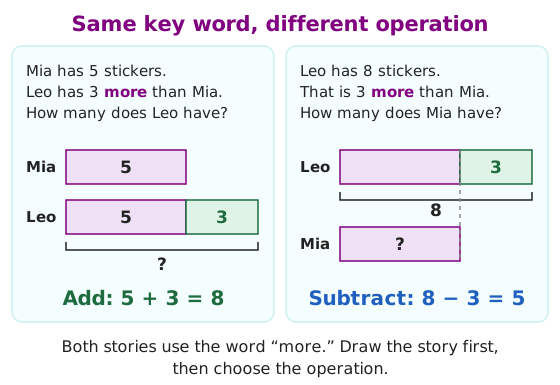
Each problem has three lines: Operation, Equation, and Answer. Before you choose the operation, ask yourself what the story is about: putting amounts together, taking away, comparing two amounts, or making equal groups. The picture shows how the same key word, “more”, can mean add in one story and subtract in another.
Omar has 42 cards. That is 15 fewer than Mia has. How many cards does Mia have?
- The key word “fewer” makes many students subtract. But read who has fewer: Omar has fewer, so Mia has more.
- To find the bigger amount, add the difference to the smaller amount. The operation is addition.
- The equation is 42 + 15 = 57.
Mia has 57 cards. “Fewer” was a keyword trap.
72 pencils are put into boxes with 8 in each box. How many boxes are needed?
- The key word “each” often means multiply. But here you already know the total, 72 pencils.
- You are looking for the number of equal groups, so the operation is division.
- The equation is 72 ÷ 8 = 9.
9 boxes are needed. “Each” was a keyword trap.
The Most Common Keyword Trap
Seeing “how many more” and adding. “How many more” compares two amounts, so you subtract the smaller amount from the larger one.
For example, if Leo has 64 stamps and Hana has 29 stamps, Leo has 64 − 29 = 35 more stamps than Hana. Adding 64 + 29 = 93 gives the total, which answers a different question.
A family paid $48 in total for 4 tickets that cost the same. Which operation do you use to find the cost of one ticket?
Show answer
Division: 48 ÷ 4 = 12, so one ticket costs $12. “In total” often means add, but here you know the total and the number of equal tickets, so you divide.
For more key word lists and traps, see key words in math word problems.