Types of Quadrilaterals
Recommended Lessons
Not sure where to start? These are the lessons and games we recommend most to students, parents and teachers on Basic-mathematics.com. Each lesson explains the topic in plain language, walks you through worked examples step by step, and ends with practice so you can check your understanding. Pick one below, or use the menu to find lessons on fractions, algebra, geometry, statistics and more.
In this lesson, you will learn
- The six common types of quadrilaterals and how to tell them apart
- Which sides are parallel or equal, and which angles are equal, in each type
- The three types of trapezoids
- How to name any quadrilateral by asking a few questions about its sides and angles
A quadrilateral is a polygon with four sides, four angles and four vertices.
There are six common types of quadrilaterals, and these quadrilaterals can be classified by the relationships of their sides and angles.
How to Identify a Parallelogram
A parallelogram is a four-sided polygon with two pairs of parallel and equal sides.
The following figure is a parallelogram.
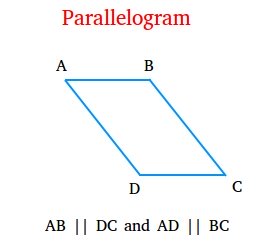
In a parallelogram, all the following are true:
- Opposite sides are parallel (AB || DC and AD || BC)
- Opposite sides are equal (AB = DC and AD = BC)
- Opposite angles are equal (angle A = angle C and angle B = angle D)
In parallelogram ABCD, angle B = 115°. What is angle D?
Show answer
Angle D = 115°. Angles B and D are opposite angles, and opposite angles in a parallelogram are equal.
How to Identify a Rectangle
A rectangle is a parallelogram with 4 right angles.
The following figure is a rectangle.
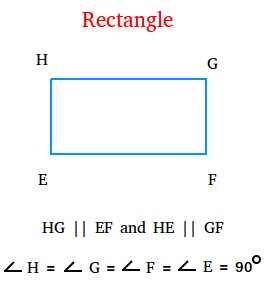
In a rectangle, all the following are true:
- Opposite sides are parallel (HG || EF and HE || GF)
- Opposite sides are equal (HG = EF and HE = GF)
- All four angles are equal to 90 degrees (angle E = angle F = angle G = angle H = 90 degrees)
Is every rectangle also a parallelogram?
Show answer
Yes. A rectangle has two pairs of parallel and equal sides, so it is a parallelogram. It is a special one, because all four of its angles are right angles.
How to Identify a Square
A square is a rectangle with 4 equal sides.
The following figure is a square.
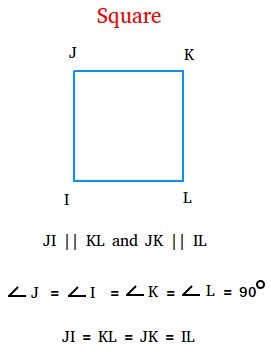
In a square, all the following are true:
- Opposite sides are parallel (JK || IL and JI || KL)
- All four sides are equal (JI = KL = JK = IL)
- All four angles are equal to 90 degrees (angle I = angle J = angle K = angle L = 90 degrees)
Thinking that a square is not a rectangle. Every square is a rectangle, because it is a parallelogram with 4 right angles. But not every rectangle is a square: a rectangle only needs its opposite sides to be equal.
A rectangle has sides of 6 cm, 4 cm, 6 cm and 4 cm. Is it a square?
Show answer
No. A square needs all four sides to be equal. Here two sides are 6 cm and two sides are 4 cm.
How to Identify a Rhombus
A rhombus is a parallelogram with 4 equal sides.
The following figure is a rhombus.
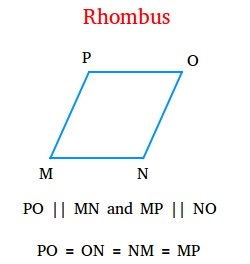
In a rhombus, all the following are true:
- Opposite sides are parallel (PO || MN and PM || ON)
- All four sides are equal (PO = ON = NM = MP)
- Opposite angles are equal (angle M = angle O and angle N = angle P)
A square and a rhombus both have 4 equal sides. The difference is the angles: a square has 4 right angles, while a rhombus does not need to have any.
In rhombus MNOP, side PO = 9 cm. How long is side NM?
Show answer
NM = 9 cm. All four sides of a rhombus are equal.
How to Identify a Trapezoid
A trapezoid is a quadrilateral with only one pair of parallel sides.
There are three common types of trapezoids.
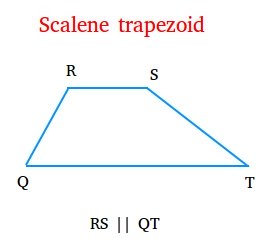
Scalene trapezoid
A scalene trapezoid is a trapezoid with no equal sides. The following is a scalene trapezoid.
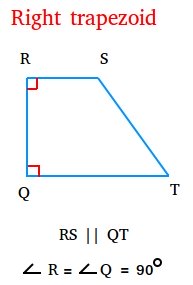
Right-angled trapezoid
A right-angled trapezoid is a trapezoid with two right angles. The following is a right-angled trapezoid.
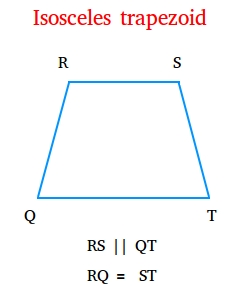
Isosceles trapezoid
In an isosceles trapezoid, the non-parallel sides are equal. The following is an isosceles trapezoid.
A quadrilateral has exactly one pair of parallel sides, and its two non-parallel sides are both 5 cm long. What type of quadrilateral is it?
Show answer
An isosceles trapezoid. One pair of parallel sides makes it a trapezoid, and equal non-parallel sides make it isosceles.
How to Identify a Kite
A kite is a quadrilateral with two pairs of adjacent sides that are equal. Furthermore, no opposite sides are equal.
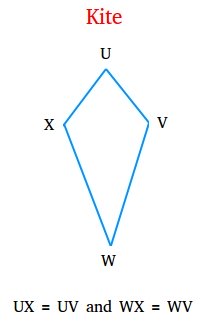
Looking for equal opposite sides in a kite. In a kite, the equal sides are next to each other (adjacent): UX = UV and WX = WV. If the opposite sides are equal, the shape is a parallelogram, not a kite.
In kite UVWX, UX = 4 cm and WV = 9 cm. How long are UV and WX?
Show answer
UV = 4 cm and WX = 9 cm. UV is next to UX and equal to it, and WX is next to WV and equal to it.
How to Identify Any Quadrilateral
To name a quadrilateral, ask these questions in order.
- How many pairs of parallel sides does it have? Two pairs: it is a parallelogram (go to question 2). One pair: it is a trapezoid (go to question 3). None: check whether it is a kite (two pairs of equal adjacent sides).
- For a parallelogram, look at the angles and sides. 4 right angles and 4 equal sides: square. 4 right angles only: rectangle. 4 equal sides only: rhombus. Neither: parallelogram.
- For a trapezoid, look at the non-parallel sides. Equal: isosceles trapezoid. Two right angles: right-angled trapezoid. No equal sides: scalene trapezoid.
- Count the pairs of parallel sides: there are two pairs, so it is a parallelogram.
- Check the angles: 60° and 120° are not right angles, so it is not a rectangle or a square.
- Check the sides: all four sides are 5 cm, so the sides are equal.
- A parallelogram with 4 equal sides and no right angles is a rhombus.
Answer: it is a rhombus.
A quadrilateral has no parallel sides. Its two top sides are 3 cm each, and its two bottom sides are 8 cm each. What type of quadrilateral is it?
Show answer
A kite. It has two pairs of equal adjacent sides, and no opposite sides are equal.
Summary
- A parallelogram has two pairs of parallel and equal sides, and its opposite angles are equal.
- A rectangle is a parallelogram with 4 right angles. A rhombus is a parallelogram with 4 equal sides.
- A square is a rectangle with 4 equal sides, so it is also a rhombus and a parallelogram.
- A trapezoid has only one pair of parallel sides. It can be scalene, right-angled or isosceles.
- A kite has two pairs of equal adjacent sides, and no opposite sides are equal.
Test Yourself: 10-Question Quiz
Now check what you learned. Every answer is explained, and each time you play you get new questions.
Quiz Complete!